
A Discovery From Jülich-Berg
by Joachim Stollhoff
The coin presented here is one not previously known. We are not talking about a new date on a coin type we already know – this really is a new coin type with an otherwise undocumented value: a coin of 6 Albus light minted by the Herzogtum (Duchy) Jülich-Berg in the year 1640.
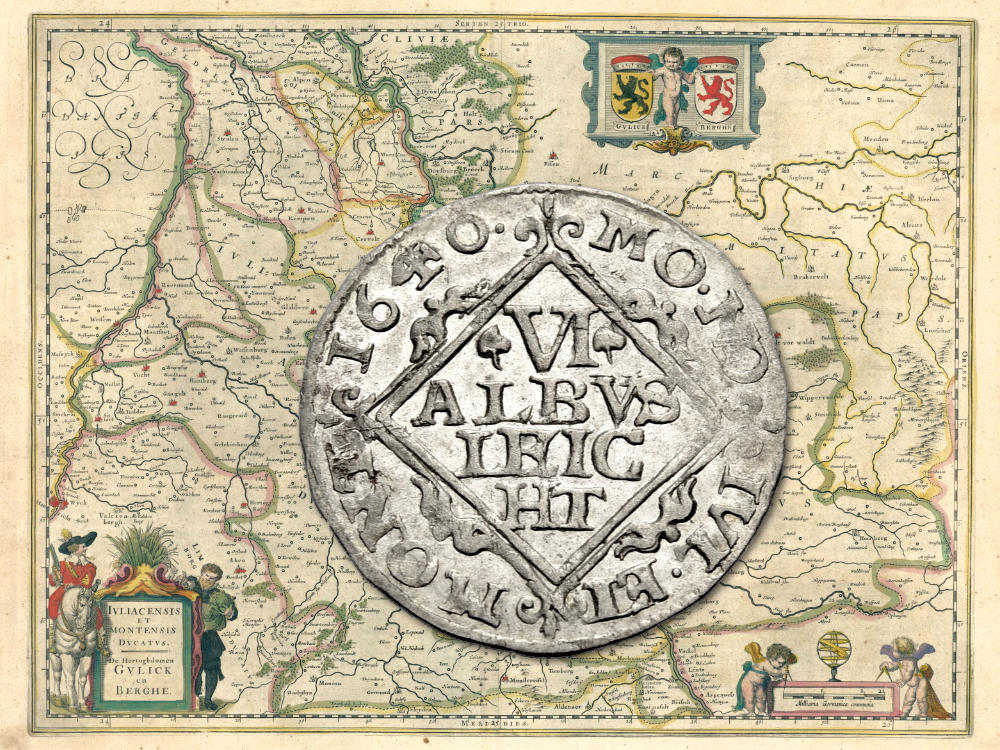
A map of the Duchy of Jülich-Berg by Willem and Joan Blaeu, 1645 and the reverse of the newly discovered denomination of a 6 Albus light of 1640.
In 1640, the Thirty Years’ War was still raging in Europe. The „Kipperzeit“ of rapid currency debasement had been brought under control since 1623, but there was an acute shortage of money in all the countries involved, and the price of war had been high. The currency which was most widely used on the Lower Rhine was the “kölnische” (“from Cologne”) or heavy Albus. North of Cologne, the light Albus was created, which corresponded to the heavy Albus with a value ratio of 5 to 4. Five light Albus corresponded to four kölnische or heavy Albus. Cologne began minting four Albus coins in 1627, while in 1629, Jülich-Berg began minting five light Albus, which had the same value as four Cologne Albus. From 1636, Jülich also minted four Albus “kölnisch,” which was the same value of money in the heavy currency. In 1640 and 1641, coins valued at 10 light Albus were minted at the Jülich mint in Düsseldorf, which correspond to 8 Albus kölnisch and fit into the system perfectly. To sum up, we have:
- 4 heavy Albus= 5 light Albus
- 8 heavy Albus= 10 Albus light
The minting process was controlled by an organisation of the Rhenish counties and principalities (Niederrheinisch- Westfälische Reichskreis). At the trial day in May 1636, when the new coins were tested for quality, the new moneyer in Düsseldorf, Simon Huber, proposed a range of new denominations, including the five light Albus, as they had previously minted, and six light Albus, which was a new value class. The council in charge of the trial allowed him to mint 50 Marks fine silver worth of the new six Albus light coins. “The minting list makes no mention of the first coins to be presented (i.e. the 6 Albus light, undated), and none of them have been preserved” (Noss, p. 86).
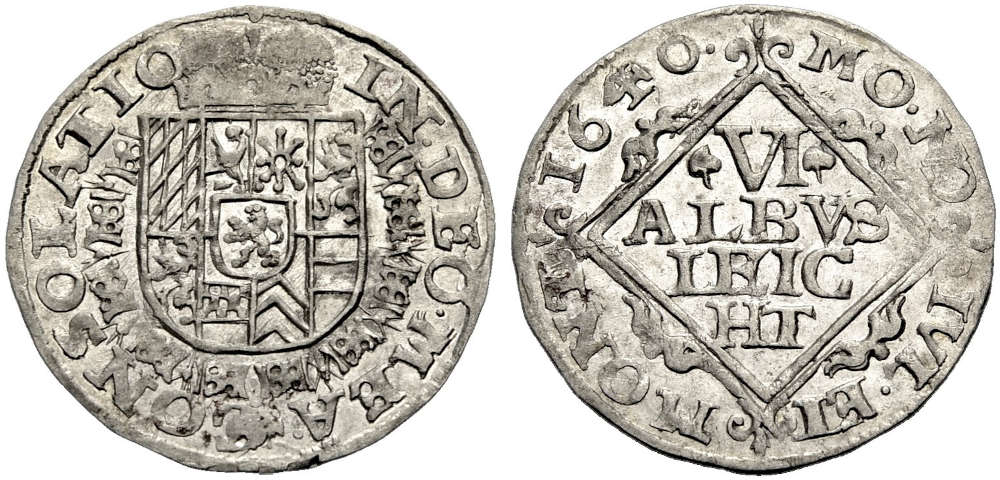
Jülich-Kleve-Berg. Wolfgang Wilhelm von Pfalz-Neuburg (1614-1653). 6 Albus light 1640. A previously unknown denomination! Only known specimen. Extremely Fine. From Münzen & Medaillen GmbH Auction 50 (27 June 2023), lot 575. Starting price: 1,600 EUR.
Noss then describes the trial day in early 1640: “In the boxes of Jülich were coins with the denomination 6 light Albus, which the moneyer had already been given permission to mint in 1636. This was a lot of 46 Marks, comprising about 4140 coins, of which up to the present day not a single one has ever been found. The denomination was never minted again. It had not proved fit for purpose, presumably because it did not integrate perfectly with the heavier Cologne system” (Noss, p. 86).
In the list of coins struck in 1636-1653 on p. 92, Noss records the production of 46 Marks worth of light Albus in the year 1639, based on the protocoll of the trial day. For 1640, he records 75 Marks worth of 10 Albus light, but no 6 Albus. Because the trial day in 1640 took place in the early part of the year, the boxes containing the coins to be tested probably only contained coins from the year 1639.
The coin presented here is dated 1640. The 4 is hardly elegantly formed, but it is definitely not a re-worked 3, and the 0 was never a 9. The 4 gives the impression that the diecutter, not having a suitable punch, created a 4 by crossing two I punches and adding a connecting line. But the date 1640 has not been changed from 1639 in the die.
I thank Mr. H.-W. Müller from MünzZentrum Rheinland, who knows the coins from Jülich well, for confirming that a coin of this type was also unknown to him.
The coin will be up for sale in Münzen & Medaillen GmbH, Auction 50, on 27th June 2023 as lot 575.