






CoinsWeekly Special for the ANA World’s Fair of Money Chicago 2024
by Ursula Kampmann
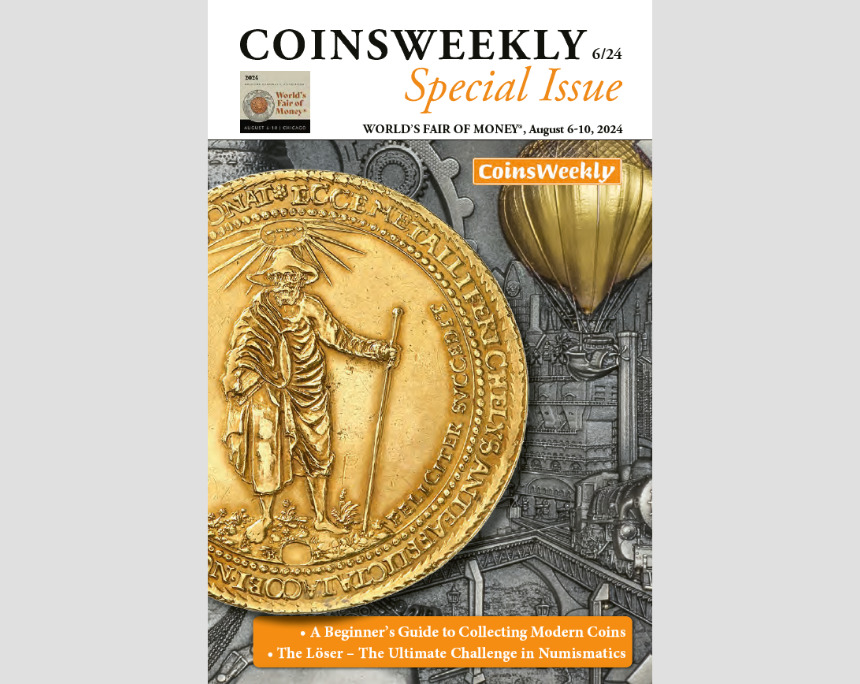
On the occasion of the ANA World’s Fair of Money in Chicago, we are publishing our sixth printed CoinsWeekly Special of 2024. It includes a helpful beginner’s guide to collecting modern coins.
In 1979, I made my first trip to the United States of America. I went there as a high school student on a student exchange program. Can you even imagine how nervous I was? 14 years old, in a country whose language I struggled with, a little too tall, a little too fat, a little too loud, and certainly not what people would call ‘cool’ today. And there I was, in a small town on Lake Michigan, attending Rogers High School. What really got me down at the time was that all the boys and girls were staring at my feet. Was there something wrong with them? To me, they looked just like everybody else’s feet. It took me two weeks to work up the courage to ask – and the answer shocked me: people were wondering where my boots were. All Germans wore boots, didn’t they? At least that’s what many people at the school believed. They had watched too many Nazi movies and expected me, as a German, to fit the Hollywood stereotype of a Nazi.
Today, I just want to laugh at this story. It seems to be from another time. And yet there is a hint of bitterness in my smile. Because there are again people in Germany today who share Nazi ideas. Nationalism is on the rise, and not only in Germany.
There is nothing wrong with being proud of your country – but problems arise when such feelings are accompanied by an attitude of looking down on people from other nations. And this brings me to the task that, in my opinion, collecting and collectors have been taking on since the 19th century: serious collectors are always in close contact with collectors and dealers beyond their own borders. At its best, this close contact creates understanding and respect for others. To me, these two concepts are the key to peaceful and prosperous coexistence.
That’s why I think international events like the annual ANA Convention are so important. They are about so much more than business. They are about getting to know each other, breaking down stereotypes, and enjoying one of the greatest pleasures in this world: coins.
Come and visit us at our booth 1532! Talk to us about whatever is on your mind, and preferably about every single aspect of numismatics!
