






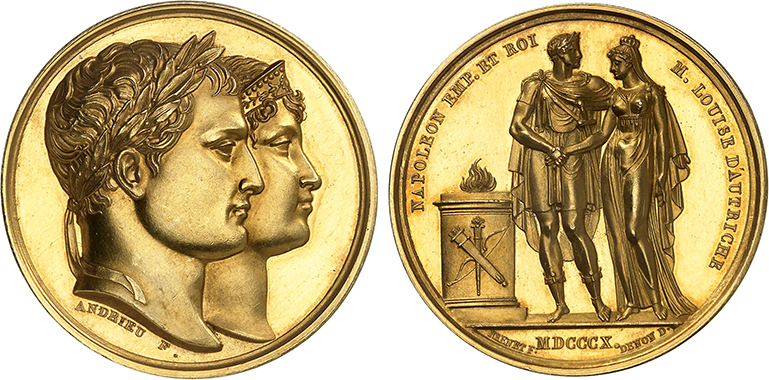
Goldmedaille, auf die Vermählung mit
Maria Louise von Österreich.
Vorzüglich.

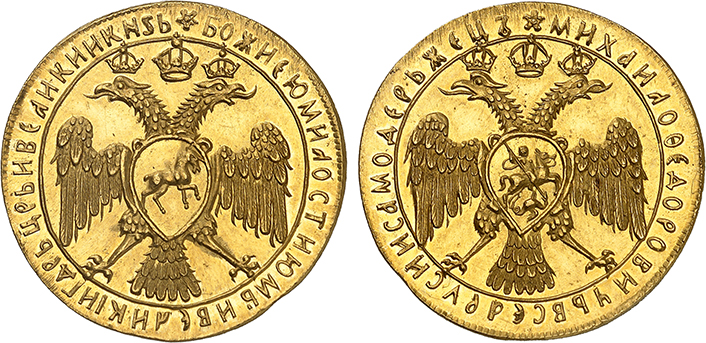
Michael Feodorowitsch, 1613-1645.
4 Dukaten o. J., St. Petersburg. Novodel.
Very rare.
Vorzüglich bis Stempelglanz.
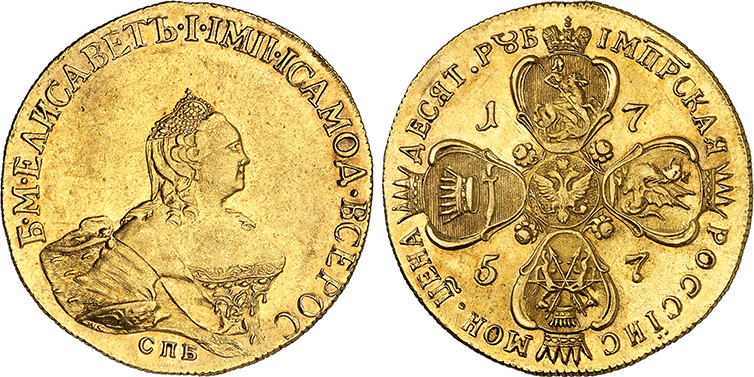
Elisabeth I., 1741-1761.
10 Rubel 1757, St. Petersburg.
Very rare.
Fast vorzüglich.
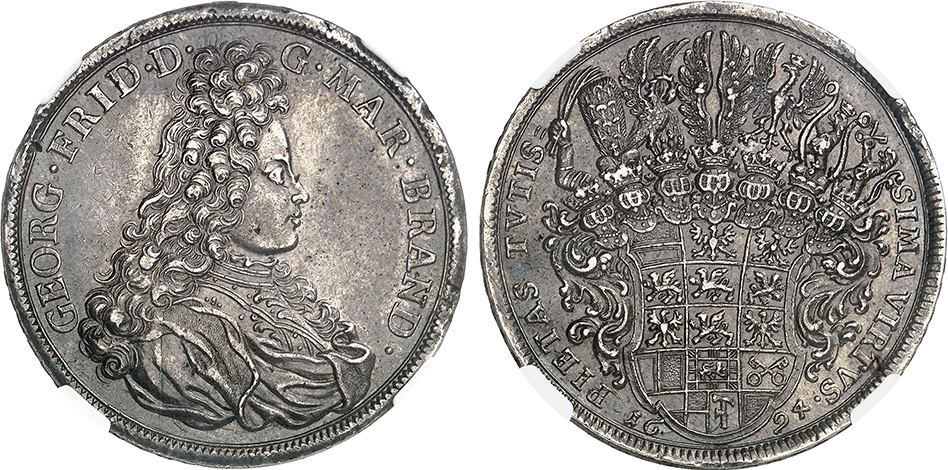
Georg Friedrich "der Jüngere", 1692-1703.
Taler 1694, Schwabach.
Mit Randschrift.
Very rare.
NGC AU55. Gutes vorzüglich.
Georg Wilhelm, 1712-1726.
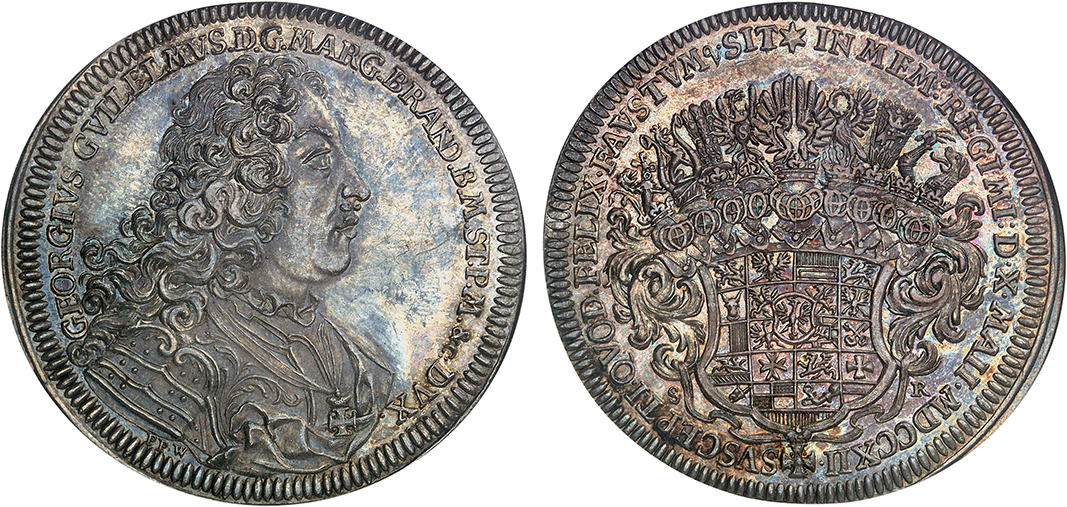
Taler 1712, auf den Regierungsantritt.
Very rare.
NGC MS64. Stempelglanz.
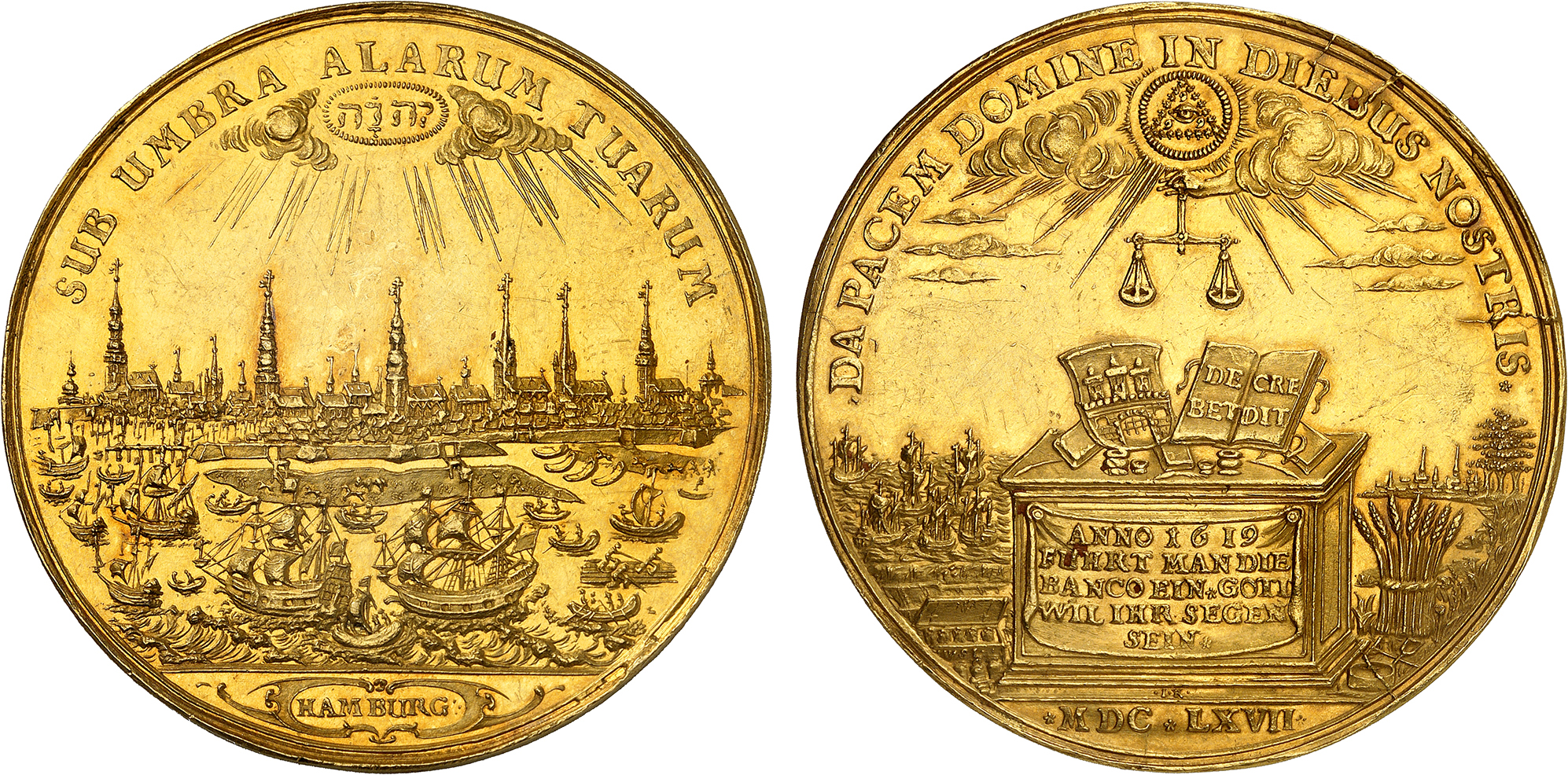
Bankportugalöser zu 10 Dukaten 1667.
Very rare.
Vorzüglich.
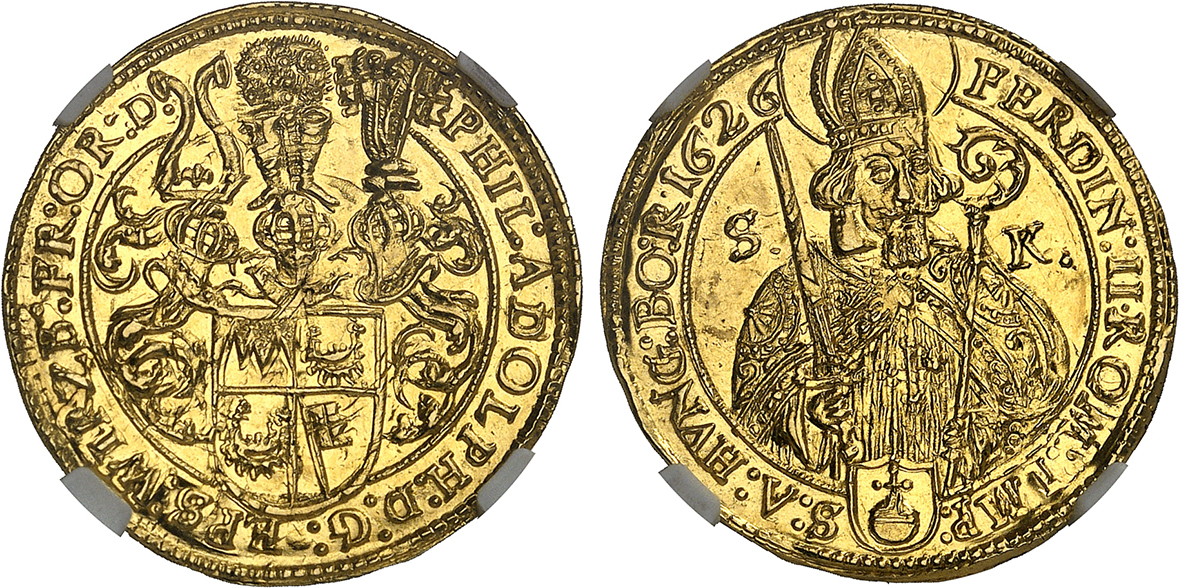
Philipp Adolph von Ehrenberg, 1623-1631.
Goldgulden, 1626.
Extremely rare.
NGC MS62. Stempelglanz.
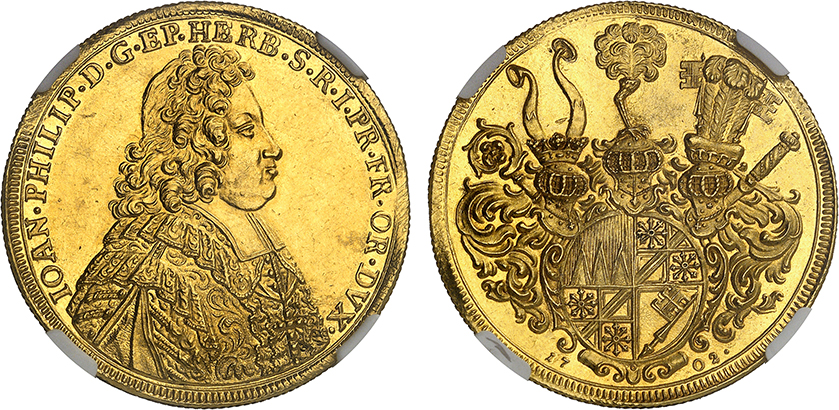
Johann Philipp von Greiffenklau zu Vollraths, 1699-1719.
5 Dukaten 1702.
Extremely rare.
NGC MS63. Prägefrisch.
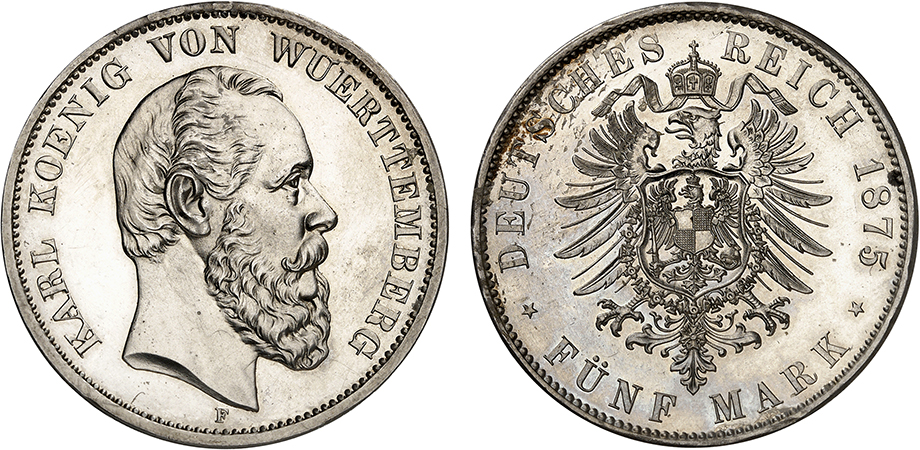
5 Mark 1875.
Extremely rare in this condition.
Polierte Platte.
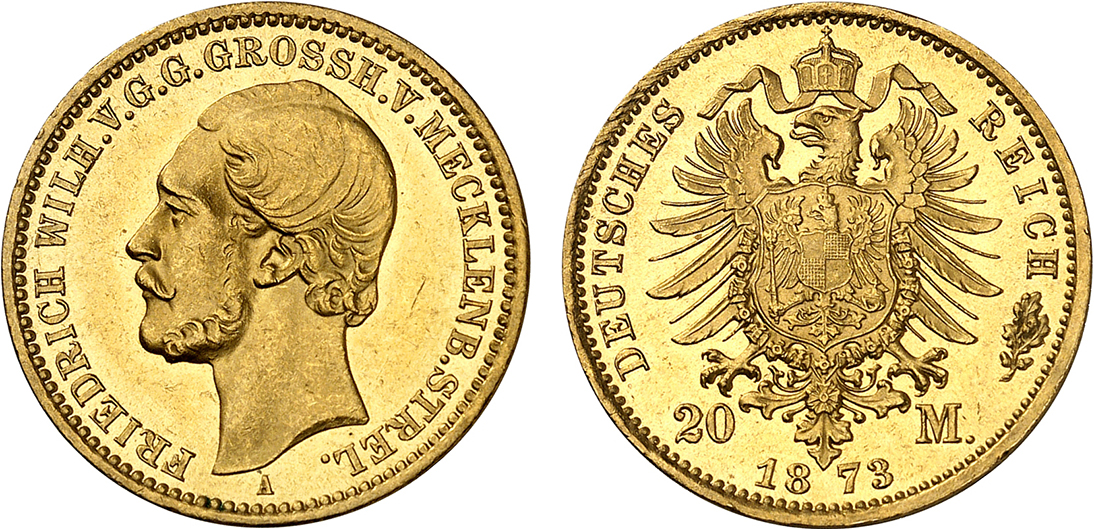
20 Mark 1873.
Extremely rare in this condition.
Fast Stempelglanz.
Call for Papers: Conference on Ancient Coin Legends in June 2025
From 26th to 28th June 2025 the conference Ancient coin legends: composition, design, lexicography, and framing potential will be held in Munich (Residenz München). The event is organised by Dr. Hongxia Zhang and Prof. Dr. Sven Günther from the Institute for the History of Ancient Civilizations (IHAC), Northeast Normal University, Changchun, China, and Dr. Elisabeth Günther from Institute for Classical Archaeology and Byzantine Archaeology, University of Heidelberg.
![Reverse of a coin type of Emperor Hadrian (RIC II, Part 3 [second edition] Hadrian, nos. 1573-1579). The clockwise-running coin legend is arguably exactly placed this way to name the two figures of the image, Emperor Hadrian (left) and personified Gallia (right). Copyright: IHACOINS, Institute for the History of Ancient Civilizations, Changchun, China.](https://new.coinsweekly.com/wp-content/uploads/2024/09/2024KW37aNews05EN_00.jpg "Reverse of a coin type of Emperor Hadrian (RIC II, Part 3 [second edition] Hadrian, nos. 1573-1579). The clockwise-running coin legend is arguably exactly placed this way to name the two figures of the image, Emperor Hadrian (left) and personified Gallia (right). Copyright: IHACOINS, Institute for the History of Ancient Civilizations, Changchun, China.")
Reverse of a coin type of Emperor Hadrian (RIC II, Part 3 [second edition] Hadrian, nos. 1573-1579). The clockwise-running coin legend is arguably exactly placed this way to name the two figures of the image, Emperor Hadrian (left) and personified Gallia (right). Copyright: IHACOINS, Institute for the History of Ancient Civilizations, Changchun, China.
As essential part of coinage, ancient coin legends have, however, received much less attention than the imagery that has been intensively studied by numismatists, historians, archaeologists, iconographists, and others. While legends have been often used for die studies, that is, from a rather technical point of view, or for solving chronological issues as well as analysis of political key messages, they promise to raise new research questions with regard to semantic, aesthetic, and socio-cultural aspects.
Hence, the conference attempts to change this current imbalance in numismatic research by comprehensively examining and contextualizing legends on ancient coins of the wider Mediterranean world. This means that the lexicographical meaning of the legend text as well as its composition, design, and placement on the actual coin type will be focused on. In this regard, the juxtaposition and spatial relationship of legend and imagery and their semantic interdependencies are of special interest, as well as the selection and order of words, their at times apparent ambiguity, or their polyvalency as regards abbreviations.
Based on frames and framing methodology as developed in previous conferences we suppose that coin legends substantially contribute to the “messages” of a respective coin type established as a frame within a complex and dynamic communication process (along with the time) and are thus an inextricable part of the multimodal “medium” with its high framing potential.
The organizers invite papers that approach coin legends from a theoretical-methodological perspective or offer insights through case-studies. In particular, we seek contributions to the panels “coin legends and interdisciplinary studies”, “coin legends in the Greek & Hellenistic world”, or “coin legends during the Roman Republic”. Confirmed participants are (in alphabetical order): Sven Betjes, François de Callataÿ, Andreas Grüner, Fleur Kemmers, Clare Rowan, Ute Wartenberg. Keynote speaker is Stephanie Geise. The conference will be held in hybrid format. It is supported by the Thesaurus Linguae Latinae, the Staatliche Münzsammlung München, and the Kommission für Alte Geschichte und Epigraphik. Selected papers are intended to be published in a special issue of the double-blind peer-reviewed Journal of Ancient Civilizations (JAC). The organizers currently apply for funding for travel and accommodation, yet any financial subsidies can only be confirmed at a later stage of the process. The Deadline for abstracts is 31st October 2024.
