







ROMA Numismatics to Close on 24 May 2024
by Ursula Kampmann, translated by Maike Meßmann
On 24 May 2024, a rather sad chapter in the history of British numismatics will come to an end. The Antiques Trade Gazette has reported that the ROMA Numismatics auction house is to close. It appears that the remaining inventory, as well as coin trays and coin boxes, were sold at a final auction sale on 24 and 25 April 2024.
Content

A Rebel in the Coin Trade
When Richard Beale opened his new coin shop, industry experts were amazed at how quickly he was able to attract large-scale consignments for his sales. As early as on 15 October 2010, the first floor auction was held at the prestigious Cavendish Hotel. If you flick through the auction catalogue of the time, you will quickly realise that this is certainly not the typical catalogue of a newly founded auction house. The 556 lots included a high-quality collection of rare Roman Republican denarii in excellent condition, as well as a total of 35 coins with five-figure estimates. In contrast, only about 30 of the lots offered had a traceable provenance.
The second sale was even more impressive. It included an Attic decadrachm with an estimate of £125,000 that sold for £150,000. It came from “an English private collection” and had first been published in the Swiss Numismatic Review in 2009.
Naturally, many people wondered how Richard Beale was able to secure so many attractive consignments for ROMA. It was not only due to Beale’s persuasive and professional manner. A key reason for his success was that he was unscrupulous enough to undercut many established auction houses when it came to consignor fees. ROMA still states on its website that it is prepared to waive all seller’s fees, offer cash advances of up to 50% of the consigned coins’ value with 0% interest, and fast turn-around, often within a single month.
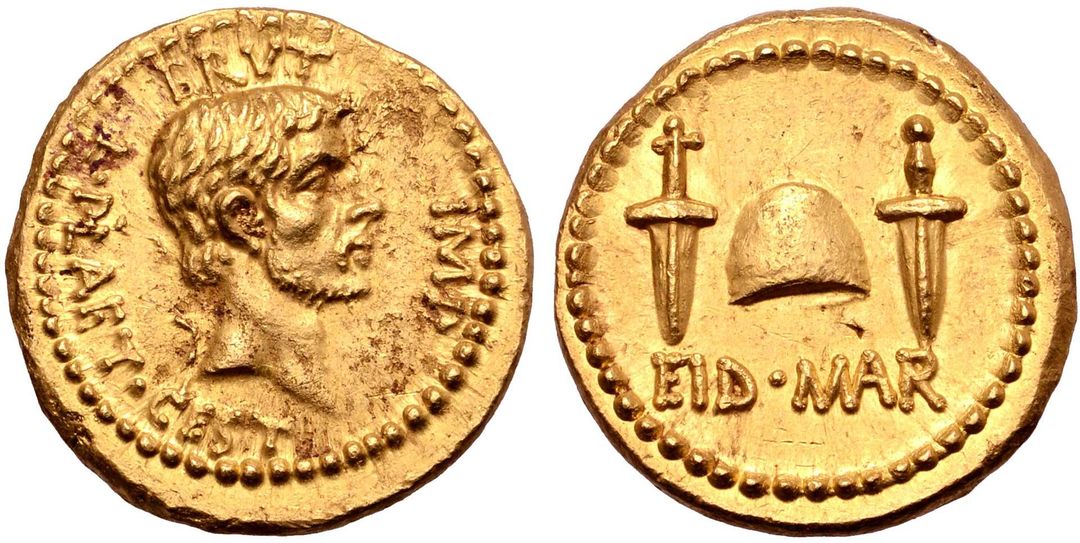
M. Iunius Brutus. Aureus, 42 BC, military mint in the east. From Roma auction XX (2020), lot 463. Hammer price: 3,240,000 pounds.
Falsified Provenances
During the Munich NUMISMATA, it became known that Richard Beale had been arrested in New York in January 2023. The Manhattan District Attorney’s office accused him and the internationally-connected coin dealer Italo Vecchi of falsifying the provenance of a Brutus EID MAR aureus. This piece of news made headlines around the globe, as this very aureus had set up a new record as the world’s most expensive ancient coin when it was sold at auction in October 2020 for £3.24 million. This record was broken in May 2023. During another hearing at the New York Supreme Criminal Court on 14 August 2023, Richard Beale confessed that he had indeed committed this and other crimes as alleged by the prosecution. It has been verified that Dominique de Chambrier had sent an email and a letter to the ROMA auction house in October 2020 asking them to withdraw the false provenance of the EID MAR aureus as well as that of a Naxos tetradrachm, which were claimed to come from his property.
Moreover, the events surrounding the Gaza Hoard – which had been the subject of a major BBC documentary in 2020 – were addressed. In the course of their journalistic work, BBC representatives confronted Richard Beale with their well-founded suspicion that the Alexander decadrachms auctioned by him were part of the Gaza Hoard. The provenance was given as either a Canadian or a European private collection. Richard Beale responded with the following statement: “We were satisfied that the consignor(s) were known to us, and had an established record of professionalism and trust. Furthermore, we were provided with information that the items had entered the UK from an origin country that raised no concern.” In fact, as he admitted to the New York judge, he was aware that the coins came from the Gaza Hoard. The invented provenances served to conceal this fact.
Consequences for the Coin Trade
The closure of ROMA Numismatics appears to have been a well-planned and fairly conducted auction. Customers who had (and still have) goods at ROMA have been asked to contact their customer service. A number of staff have found new jobs at other auction houses in recent weeks.
The disappearance of the most important numismatic auction house in the UK opens up space for other auctioneers. The winners are likely to be well-known brands such as Baldwin’s and Spink, but also newcomers such as The Coin Cabinet, which has expanded its portfolio to include the trade in ancient coins. After all, founded by Andreas Afeldt, The Coin Cabinet describes itself as “the UK’s fastest-growing coin auction company”.
