






CoinFindsViewer – Roman Coin Finds in Southern Germany
The CoinFindsViewer project represents the first large-scale visualization of Roman coin find data in southern Germany. It enables users to interactively explore the dataset along the Roman frontier, the Limes, and its hinterland across various historical periods. CoinFindsViewer emerged from a collaboration between the Master’s specialization in Digital Humanities and Project B02 of the Collaborative Research Center (CRC) 1391.
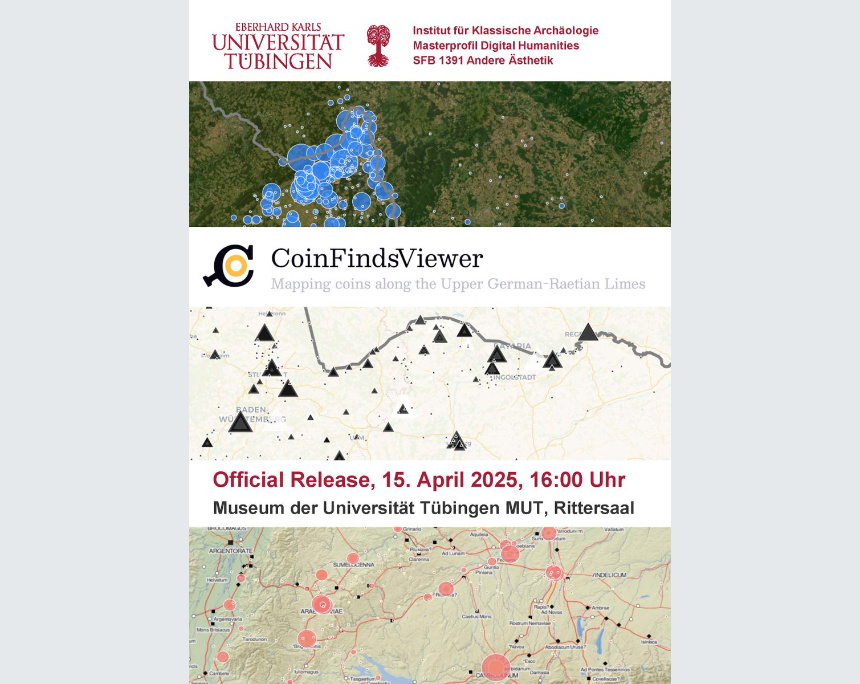
Launch poster. Image: Stefan Krmnicek, Project Director.
The dataset of CoinFindsViewer comprises 81,316 Roman coins from the Corpus of Roman Coin Finds in Germany (FMRD), which have been digitized and processed according to the latest scholarly standards. Simon Holzner developed a geoinformatics-based web application into which he integrated the coin data, laying the conceptual foundation for the current visualizations.
The visualization tool is divided into four historical periods representing key phases in the region’s Roman history:
- Pre-Limes Period
- Neckar Limes
- Upper German-Raetian Limes
- Fall of the Limes
Within these four periods, users can filter coins by base (AE) and precious (AR + AV) metals, both in terms of quantity and value (calculated in sestertii). CoinFindsViewer further visualizes coins by specific denominations, including as (As), dupondius (Dp), sestertius (HS), denarius (D), antoninianus/radiate (Rad), and aureus (Au). CoinFindsViewer also supports flexible sorting across all four periods based on diachronic and thematic search parameters.
Please note that the data in CoinFindsViewer are continuously revised and updated, and should not be considered final. The data are based on the version as of 15 April 2025. Should you encounter any errors or have any questions, please contact the project team, who will be happy to assist you.
