






Conference on Ancient Coin Legends in Munich 2025
The conference “Ancient coin legends: composition, design, lexicography, and framing potential” will take place from 26 to 28 June 2025 in Munich, Residenz (Bavarian Academy of Science).
Content
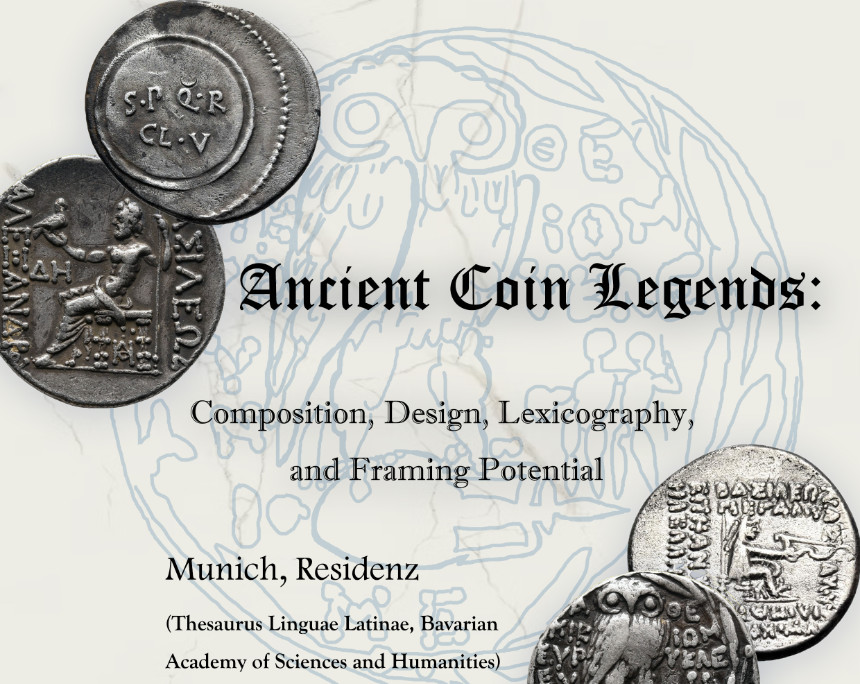
The conference shall shed light on the communicative dynamics of ancient coins legends – in their interdependency with imagery and material qualities of the coins – and place them in an interdisciplinary field of media studies, philological & historical approaches, numismatics, archaeology (material aspects) and iconography/design analysis. We consider coin legends to be a promising, yet so far never comprehensively explored starting point for new research questions regarding lexical, semantic, aesthetic and socio-cultural aspects.
Therefor we use the modern concept of “framing” as a theoretical-methodological backbone. Today, the term ‘framing’ commonly refers to political framing, which aims at influencing target audiences, or is applied to analyse selling strategies in advertisements. However, the concept has already proven to be a useful tool for interdisciplinary source criticism in ancient studies. This couples well together with the materiality-oriented concept of ‘affordances’ as the sending of messages is an integral quality of a coin (based on a specific type or even series) which is designed to look at the text-imagery filled frame in the small round with its limited space.
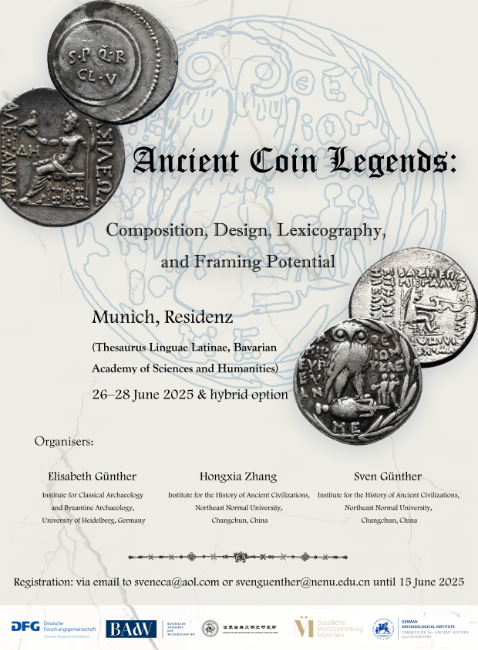
The poster for the conference. It will deal with the various aspects of legends on ancient coins.
Due to the context-related possibility of different interpretations – depending also on the respective experiences and expectations of the audience(s) both on a collective and individual level – framing naturally includes the possibility of different layers or levels of meanings. Such ambiguity might be unexpected for the producer but can also be an intended polyvalency which helps to spread different messages amongst a heterogeneous audience, not only at the edges of empires.
By discussing the manifold dimensions of ancient coin legends in the wider Mediterranean region, we will not only cope with the multimodal character of coins in dynamic communication processes, but also allow particularly for an interdisciplinary exchange and new perspectives on ancient coin production and reception.
Conference Programme
26 June 2025 (afternoon & evening)
- 14.30–15.00: welcome addresses & thematic introduction (representative(s) from co-organising institutions; organisers E. Günther; H. Zhang; S. Günther)
Panel 1: coin legends and interdisciplinary studies
- 15.00–15.45: Andreas Grüner (Classical Archaeology, FAU Erlangen-Nürnberg): “Epigraphica numismatica: giant letters and minuscule coins.”
- 15.45–16.30: Francois de Callataÿ (Royal Library Belgium, Brussels): “To properly read monetary legends: a preliminary but often tricky task for 16th–18th c. numismatists.”
- reception in Bavarian Academy of Sciences and Humanities
- 17.30–18.30: keynote by Prof. Dr. Stephanie Geise (Professor for Communication and Media Studies, Centre for Media, Communication and Information Studies, University of Bremen): “The logic of Visual Framing: patterns, potentials & effects.”
27 June 2025 (full day)
Panel 2: coin legends in the Greek & Hellenistic world
- 8.30–9.15: Ute Wartenberg (Sydney F. Martin Executive Director, American Numismatic Society, New York): “Voices of the provinces: multilingualism in Achaemenid coinage.”
- 9.15–10.00: Caterina Schorer (Classical Archaeology, University of Heidelberg & University of Zurich): “Framing a parasemon: coin legends of Elea in Classical and Hellenistic periods.”
- Coffee break
- 10.30–11.15: Annette Haug (Classical Archeology, University of Kiel) / Ulrike Peter (Berlin-Brandenburg Academy of Sciences and Humanities): “Texts and images on Greek coins between paratextuality and parapictoriality.”
- 11.15–12.00: Gunnar Dumke (Coin Cabinet Winterthur): “basileus and maharaja – reading (and understanding) Indo-Greek coin legends.”
- Lunch break
Panel 3: coin legends during the Roman Republic
- 14.00–14.45: Manfredi Zanin (Ancient History, University of Bielefeld): “Not one without the other. The semantic coherence of signatures, legends and portraits in Roman Republican coinage.”
- 14.45–15.30: Hongxia Zhang (IHAC, NENU, Changchun): “Aristocratic messages on Roman Republican coin legends.”
- Coffee break
- 16.00–16.45: Niklas Unterdörfel (Helmut Schmidt-University Hamburg): “The bilingual Neo-Punic coins of Numidia and Mauretania: cultural exchange and identity in Ancient Numismatics.”
- 16.45–17.30: Sven Günther (IHAC, NENU, Changchun): “How coin legends work at the rims of the Roman world.”
- Conference dinner
28 June 2025 (morning)
Panel 4: coin legends in the Roman Empire
- 8.30–9.15: Elisabeth Günther (Institute for Classical Archaeology and Byzantine Archaeology, University of Heidelberg): “The iconography of words. Legends as pictorial elements in Roman imperial coinage.”
- 9.15–10.00: Fleur Kemmers (Institute for Archaeological Sciences, Goethe-University Frankfurt): “Images and ambiguity, or when to (not) use a legend on Roman imperial coinage.”
- Coffee break
- 10.30–11.15: Sven Betjes (Department of History – Art History, Radboud Universiteit Nijmegen): “Engaging the viewer: the various functions of the legend in Roman imperial coinage.”
- 11.15–12.00: Clare Rowan (University of Warwick): “Everyday literacy and Roman tokens.”
- Concluding discussion
Organisers
- Elisabeth Günther (Institute for Classical Archaeology and Byzantine Archaeology, University of Heidelberg; Germany)
- Hongxia Zhang (Institute for the History of Ancient Civilizations, Northeast Normal University, Changchun, China)
- Sven Günther (Institute for the History of Ancient Civilizations, Northeast Normal University, Changchun, China)
Co-organising Institutions
- Thesaurus Linguae Latinae, Bavarian Academy of Sciences and Humanities
- State Coin Collection Munich
- Commission for Ancient History and Epigraphy, German Archaeological Institute
Sponsors
- German Research Foundation (DFG)
- Thesaurus Linguae Latinae, Bavarian Academy of Sciences and Humanities
- Institute for the History of Ancient Civilizations, Northeast Normal University
