154Prussia. Frederick William IV, 1840–1861.
Gold medal in the weight of 50 ducats
commemorating the publication of the second volume
of Alexander von Humboldt’s *Kosmos*.
NGC MS 65 PL.
From the estate of Emperor William I.
Estimate: 40.000 Euro

166Prussia. Frederick William IV, 1840–1861.
Gold medal in the weight of 50 ducats commemorating
the unveiling of the equestrian statue of
Frederick the Great on Unter den Linden in Berlin in 1851.
NGC MS 63 PL.
From the estate of Emperor William I.
Estimate: 25.000 Euro

191Prussia. William I, 1861–1888.
General’s Medal in the weight of 120 ducats, 1871,
commemorating the victory over France.
A magnificent specimen.
From the estate of Emperor William I.
Estimate: 75.000 Euro

297Russia. Nicholas I, 1825–1855. Family ruble.
1 1/2 rubles (10 zlotys), 1835, St. Petersburg.
NGC MS 64 (Top Pop).
Only 36 examples struck.
A cabinet piece from polished dies.
From the estate of King Frederick William IV.
Estimate: 250.000 Euro

1098Holland. Province.
5 ducats, 1681.
Struck with the dies of a guilder.
NGC PF 64 Cameo.
Proof.
Estimate: 40.000 Euro

1192HRE. Ferdinand II, 1592–1618–1637.
5 ducats, 1634, Vienna.
Extremely rare.
Extremely fine-uncirculated.
Estimate: 10.000 Euro

1266HRE. Vienna.
Salvator Medal in the weight of 12 ducats,
n. d.(around 1840).
NGC PF 61 CAMEO.
Proof.
Estimate: 15.000 Euro

1334City of Regensburg.
5 ducats, n. d. (1708–1710),
with the title of Joseph I. NGC MS 64.
Extremely rare. According to mint records,
only 7 copies struck.
A magnificent piece.
Estimate: 25.000 Euro

1602German New Guinea.
10 New Guinea Marks, 1895 A.
NGC MS 65.
A magnificent piece.
Estimate: 50.000 Euro

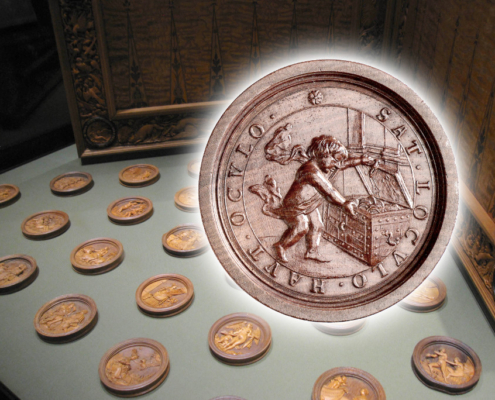
2757Saxony.
John Frederick the Magnanimous and
Maurice, 1541–1547.
Trinity Medal, 1544.
A masterpiece of German medal art. Magnificent,
excellent craftsmanship.
Estimate: 75.000 Euro

Archive: People and Markets
Interview: News From the World Money Fair

In 2024, a new generation takes over the leadership of the World Money Fair. Having hosted 17 successful events, Barbara Balz has handed over the reins to Goetz-Ulf Jungmichel. We talked to him to find out about the future course of the World Money Fair.

Social Organisations and Bundesbank Advocate for Cash

Coins and banknotes continue to hold significant importance in an increasingly digital world – a point that prominent societal figures have recently underscored in a new position paper. They highlight the social functions of cash and its vital role for disadvantaged groups.

Beautiful Stockholm. Image: Brorsson – CC BY-SA 3.0.

ICOMON Annual Conference 2024 – Call for Papers

ICOMON is looking for presentations for their annual conference 2024, which will be held in Stockholm. One topic that will be particularly in focus is Cross-Organization Collaborations. Abstracts can be submitted until 31 January 2024.

Trsat Dragon: A Field Marshal, His Tomb and a Legend

Visitors to the beautiful city of Rijeka are familiar with the two basilisks that stand guard on the Trsat hill in front of Count Laval Nugent of Westmeath’s mausoleum. The Croatian Mint dedicates a gold and a silver commemorative coin to these mythical creatures.

Archive: Coins, Medals and more

The Suffering of Leiden – A Siege During the Dutch Revolt

The third part of the Beuth Collection that Künker offers in Auction 420 contains many historically interesting emergency and siege coins. They were issued by the Dutch towns besieged by Spain during the 80 Years' War. One of these towns was Leiden, which to this day commemorates the end of the siege every year with a festival.
Karl Ludwig von Bruck, the mastermind behind the Vienna Coinage Treaty. We chose not to depict Emperor Franz Josef I at this point, who is shown on the coins, but the liberal politician Karl Ludwig von Bruck. Born into the family of a bookbinder in Elberfeld (now Wuppertal, Germany), he worked his way up from a merchant’s position to become Austria’s finance minister. He could almost be described as a beacon of hope for Austrian economic policy. It was tragic – and not just for him personally – that Franz Josef “ungraciously” dismissed him in April 1860 on false suspicions. The then 61-year-old took his own life. This deprived Austria of an imaginative politician who might have prevented its economic marginalization by Prussia.

A War Fought with Unusual Weapons: How Prussia Used Finance and Politics to Force the Habsburg Hereditary Lands Out of the German Confederation

On 26 March 2024, the Künker auction house will offer the Tursky Collection with coins of Emperor Franz Joseph I. We use specimens from this collection to tell the story of how Prussia used its economic sway to become the sole hegemonic power in Germany.
Search Search