154Prussia. Frederick William IV, 1840–1861.
Gold medal in the weight of 50 ducats
commemorating the publication of the second volume
of Alexander von Humboldt’s *Kosmos*.
NGC MS 65 PL.
From the estate of Emperor William I.
Estimate: 40.000 Euro

166Prussia. Frederick William IV, 1840–1861.
Gold medal in the weight of 50 ducats commemorating
the unveiling of the equestrian statue of
Frederick the Great on Unter den Linden in Berlin in 1851.
NGC MS 63 PL.
From the estate of Emperor William I.
Estimate: 25.000 Euro

191Prussia. William I, 1861–1888.
General’s Medal in the weight of 120 ducats, 1871,
commemorating the victory over France.
A magnificent specimen.
From the estate of Emperor William I.
Estimate: 75.000 Euro

297Russia. Nicholas I, 1825–1855. Family ruble.
1 1/2 rubles (10 zlotys), 1835, St. Petersburg.
NGC MS 64 (Top Pop).
Only 36 examples struck.
A cabinet piece from polished dies.
From the estate of King Frederick William IV.
Estimate: 250.000 Euro

1098Holland. Province.
5 ducats, 1681.
Struck with the dies of a guilder.
NGC PF 64 Cameo.
Proof.
Estimate: 40.000 Euro

1192HRE. Ferdinand II, 1592–1618–1637.
5 ducats, 1634, Vienna.
Extremely rare.
Extremely fine-uncirculated.
Estimate: 10.000 Euro

1266HRE. Vienna.
Salvator Medal in the weight of 12 ducats,
n. d.(around 1840).
NGC PF 61 CAMEO.
Proof.
Estimate: 15.000 Euro

1334City of Regensburg.
5 ducats, n. d. (1708–1710),
with the title of Joseph I. NGC MS 64.
Extremely rare. According to mint records,
only 7 copies struck.
A magnificent piece.
Estimate: 25.000 Euro

1602German New Guinea.
10 New Guinea Marks, 1895 A.
NGC MS 65.
A magnificent piece.
Estimate: 50.000 Euro

2757Saxony.
John Frederick the Magnanimous and
Maurice, 1541–1547.
Trinity Medal, 1544.
A masterpiece of German medal art. Magnificent,
excellent craftsmanship.
Estimate: 75.000 Euro

Archive: People and Markets
The British Museum: When Theft Becomes PR

Once again, the BM made negative headlines: Ilé Sartuzi stole a coin unnoticed during a hands-on tour and declared this an artistic performance. A commentary by Ursula Kampmann.

The Jewish-American Hall of Fame Presents a Medal in Honor of David Ben-Gurion

To commemorate Israel’s 75th Anniversary of Independence, the Jewish-American Hall of Fame has issued a medal commemorating featuring a portrait of “The Father of Modern Israel” – David Ben-Gurion.

A comic figure on a 2-euro coin? Slovenia honours caricaturist Miki Muster. Photo: Banka Slovenije

2-Euro Ticker: New 2-Euro Coins in June 2024

Much has happened in the 2-euro coin world in the past four weeks: new motifs for 2024 were announced and four coins were issued – however, there were some problems.

“The Art of Making Medals” Published

What Goes Into Making a Medal? Editor Ross Pollard has packed his new book “The Art of Making Medals” with practical, first-hand insights from contemporary artists into the fascinating world of medallic sculpture. Each chapter was contributed by a member of the American Medallic Sculpture Association and documents the creation of an original medal from start to finish.

Archive: Coins, Medals and more

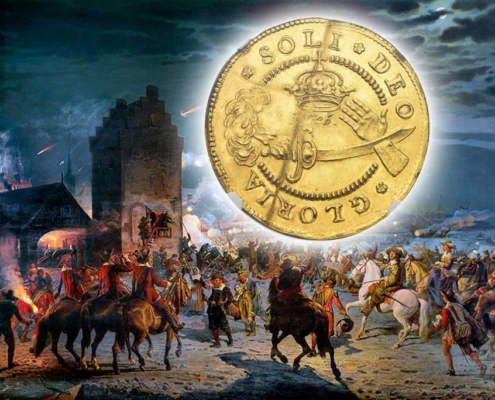
Friedrich III. auf seinem weißen Hengst bei der Verteidigung Kopenhagens 1659. Gemalt von Frederik Christian Lund, 1887. Bilder: Hintergrund: Wikimedia Commons / CC0. Münze: Auktion SINCONA 94 (22.-23. Oktober 2024), Nr. 1616.

Frederick III of Denmark and Eben Ezer

SINCONA’s Auctions 92 to 95 will take place from 21 to 25 October 2024. This article introduces one of the many rarities up for sale: a so-called “Ebenezer” coin from Denmark. The 4-Ducat piece is extremely rare and of great historical interest.
Karl Ludwig von Bruck, the mastermind behind the Vienna Coinage Treaty. We chose not to depict Emperor Franz Josef I at this point, who is shown on the coins, but the liberal politician Karl Ludwig von Bruck. Born into the family of a bookbinder in Elberfeld (now Wuppertal, Germany), he worked his way up from a merchant’s position to become Austria’s finance minister. He could almost be described as a beacon of hope for Austrian economic policy. It was tragic – and not just for him personally – that Franz Josef “ungraciously” dismissed him in April 1860 on false suspicions. The then 61-year-old took his own life. This deprived Austria of an imaginative politician who might have prevented its economic marginalization by Prussia.

A War Fought with Unusual Weapons: How Prussia Used Finance and Politics to Force the Habsburg Hereditary Lands Out of the German Confederation

On 26 March 2024, the Künker auction house will offer the Tursky Collection with coins of Emperor Franz Joseph I. We use specimens from this collection to tell the story of how Prussia used its economic sway to become the sole hegemonic power in Germany.
Search Search