154Prussia. Frederick William IV, 1840–1861.
Gold medal in the weight of 50 ducats
commemorating the publication of the second volume
of Alexander von Humboldt’s *Kosmos*.
NGC MS 65 PL.
From the estate of Emperor William I.
Estimate: 40.000 Euro

166Prussia. Frederick William IV, 1840–1861.
Gold medal in the weight of 50 ducats commemorating
the unveiling of the equestrian statue of
Frederick the Great on Unter den Linden in Berlin in 1851.
NGC MS 63 PL.
From the estate of Emperor William I.
Estimate: 25.000 Euro

191Prussia. William I, 1861–1888.
General’s Medal in the weight of 120 ducats, 1871,
commemorating the victory over France.
A magnificent specimen.
From the estate of Emperor William I.
Estimate: 75.000 Euro

297Russia. Nicholas I, 1825–1855. Family ruble.
1 1/2 rubles (10 zlotys), 1835, St. Petersburg.
NGC MS 64 (Top Pop).
Only 36 examples struck.
A cabinet piece from polished dies.
From the estate of King Frederick William IV.
Estimate: 250.000 Euro

1098Holland. Province.
5 ducats, 1681.
Struck with the dies of a guilder.
NGC PF 64 Cameo.
Proof.
Estimate: 40.000 Euro

1192HRE. Ferdinand II, 1592–1618–1637.
5 ducats, 1634, Vienna.
Extremely rare.
Extremely fine-uncirculated.
Estimate: 10.000 Euro

1266HRE. Vienna.
Salvator Medal in the weight of 12 ducats,
n. d.(around 1840).
NGC PF 61 CAMEO.
Proof.
Estimate: 15.000 Euro

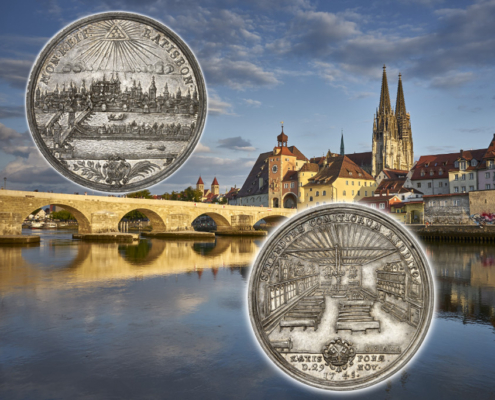
1334City of Regensburg.
5 ducats, n. d. (1708–1710),
with the title of Joseph I. NGC MS 64.
Extremely rare. According to mint records,
only 7 copies struck.
A magnificent piece.
Estimate: 25.000 Euro

1602German New Guinea.
10 New Guinea Marks, 1895 A.
NGC MS 65.
A magnificent piece.
Estimate: 50.000 Euro

2757Saxony.
John Frederick the Magnanimous and
Maurice, 1541–1547.
Trinity Medal, 1544.
A masterpiece of German medal art. Magnificent,
excellent craftsmanship.
Estimate: 75.000 Euro

Archive: People and Markets

Bowing to a Croatian Basketball Legend

In 1993, Dražen Petrović, one of the world’s most famous basketball players, died aged only 29 years. With his ambition, hard work, reliability, and modesty, the “Mozart of Basketball” continues to inspire many of his fans to this day.

Are Things Becoming Too Colourful? France and Portugal Issue 2-Euro Colour Coins

After six years, two Eurozone countries make use of the opportunity to design commemorative 2-euro coins with a special effect. Until now, official 2-euro coins with colour have been an absolute exception – for they are not at all liked to be seen in Brussels.

Unrealistic or soon to be found in European cash? This is an AI-generated image of a 2-euro commemorative coin on the subject of “defence”. Picture created with Image Generator Pro / ChatGPT

A Military Motif in Circulation – Or: How Political Should 2-Euro Coins Be?

Lithuania is planning to design a 2-euro commemorative coin for defense “against foreign armed forces”. Critics fear a numismatic mobilization – and are eagerly awaiting a possible veto from other euro countries. But have there ever been comparable cases?

Prof. Aleksander Bursche next to Ursula Kampmann at the INC 2022 in Warsaw, organized by the Polish numismatist. Photo: CoinsWeekly.

Aleksander Bursche Receives GIG Honorary Prize 2023

Aleksander Bursche will receive the 2023 Honorary Prize of the Gesellschaft für Internationale Geldgeschichte (GIG, Association for International History of Money). Not only his numismatic research work was decisive for this.

Archive: Coins, Medals and more

The Birth of the Krugerrand

The South African Krugerrand is the world’s oldest bullion coin. When it was first minted in 1967, the concept of producing a coin that matched the weight of an investment unit – one ounce – was both new and innovative. Learn more about the economic background and the meaning of its design here.
At the end of third century AD, Carausius and Allectus successively ruled Britain, and parts of the Continental coast, as rebel emperors for a period of ten years. A new book, published by Spink Books, aims to tell the incredible story of these two rebel emperors. Learn more about them and their rich coinage in this article.

Rebel Emperors of Britannia: Carausius and Allectus

At the end of the third century AD, Carausius and Allectus successively ruled Britain, and parts of the Continental coast, as rebel emperors for a period of ten years. A new book, published by Spink Books, aims to tell the incredible story of these two rebel emperors. Learn more about them and their rich coinage in this article.
Search Search