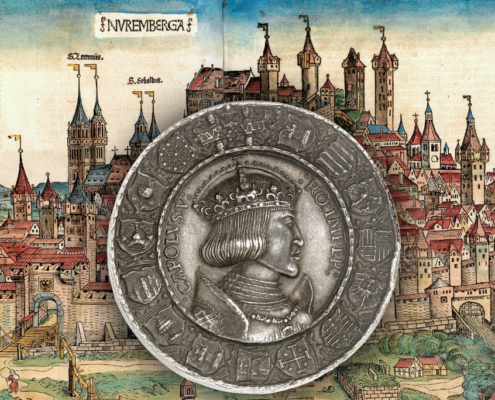
154Prussia. Frederick William IV, 1840–1861.
Gold medal in the weight of 50 ducats
commemorating the publication of the second volume
of Alexander von Humboldt’s *Kosmos*.
NGC MS 65 PL.
From the estate of Emperor William I.
Estimate: 40.000 Euro

166Prussia. Frederick William IV, 1840–1861.
Gold medal in the weight of 50 ducats commemorating
the unveiling of the equestrian statue of
Frederick the Great on Unter den Linden in Berlin in 1851.
NGC MS 63 PL.
From the estate of Emperor William I.
Estimate: 25.000 Euro

191Prussia. William I, 1861–1888.
General’s Medal in the weight of 120 ducats, 1871,
commemorating the victory over France.
A magnificent specimen.
From the estate of Emperor William I.
Estimate: 75.000 Euro

297Russia. Nicholas I, 1825–1855. Family ruble.
1 1/2 rubles (10 zlotys), 1835, St. Petersburg.
NGC MS 64 (Top Pop).
Only 36 examples struck.
A cabinet piece from polished dies.
From the estate of King Frederick William IV.
Estimate: 250.000 Euro

1098Holland. Province.
5 ducats, 1681.
Struck with the dies of a guilder.
NGC PF 64 Cameo.
Proof.
Estimate: 40.000 Euro

1192HRE. Ferdinand II, 1592–1618–1637.
5 ducats, 1634, Vienna.
Extremely rare.
Extremely fine-uncirculated.
Estimate: 10.000 Euro

1266HRE. Vienna.
Salvator Medal in the weight of 12 ducats,
n. d.(around 1840).
NGC PF 61 CAMEO.
Proof.
Estimate: 15.000 Euro

1334City of Regensburg.
5 ducats, n. d. (1708–1710),
with the title of Joseph I. NGC MS 64.
Extremely rare. According to mint records,
only 7 copies struck.
A magnificent piece.
Estimate: 25.000 Euro

1602German New Guinea.
10 New Guinea Marks, 1895 A.
NGC MS 65.
A magnificent piece.
Estimate: 50.000 Euro

2757Saxony.
John Frederick the Magnanimous and
Maurice, 1541–1547.
Trinity Medal, 1544.
A masterpiece of German medal art. Magnificent,
excellent craftsmanship.
Estimate: 75.000 Euro

Archive: People and Markets
Legal Head of Italian Culture Ministry: “Fiendishly Extensive” Proofs Bar Imports

A significant statement on the importation of numismatic goods was issued in June 2023 by the legal department of the Italian Ministry of Culture. Read an analysis by Valentina Tarquini for Cultural Property News here.

Introducing Nanoshine: CIT’s Butterfly

CIT’s Butterfly seems delicate, fragile and beautiful, just like its real-life model. The technical marvel behind it only becomes apparent at second glance. Nanoshine is a completely new technology with the potential to transform the aesthetics of coin design.

The Bank Negara Malaysia, venue of the ICOMON Annual Conference 2023. Image: Wee Hong via Wikimedia Commons / CC BY-SA 4.0.

ICOMON Annual Conference 2023: Call for Papers

The 2023 ICOMON annual conference will be held in November in Malaysia. Speakers are now invited to send their abstracts on the theme: Reinforcing Museum’s sustainable competitiveness in the peak of digitization & social/global challenges.

Donald Trump: Now Also a Coin Dealer and Designer

Supporters of the Republican US presidential candidate Donald Trump can now show their backing numismatically: following sneakers and trading cards, Trump has now launched a commemorative medal under the “Trump Coins” brand.

Archive: Coins, Medals and more

Einer der Höhepunkte von Künker Auktion 395 ist eine spektakuläre Goldmedaille zu 110 Dukaten, die aus dem persönlichen Besitz von Fürst Ferdinand I. von Bulgarien stammt. Diese Medaille führt uns mitten hinein in eine Zeit, in der Bulgarien seine Wirtschaft modernisierte. Der Fürst packte dabei tatkräftig mit an. Und die Eisenbahn spielte dabei eine zentrale Rolle.

Bulgaria, Prince Ferdinand I and the Railroad

One of the highlights of Künker’s auction 395 is a spectacular gold medal with a weight of 110 ductats. It was the personal property of Prince Ferdinand I. of Bulgaria. This medal takes us back into a period when Bulgaria modernized its economy. And the railroad system played a major role in this.

The Suffering of Leiden – A Siege During the Dutch Revolt

The third part of the Beuth Collection that Künker offers in Auction 420 contains many historically interesting emergency and siege coins. They were issued by the Dutch towns besieged by Spain during the 80 Years' War. One of these towns was Leiden, which to this day commemorates the end of the siege every year with a festival.
Search Search