Estimate: 1.300 EURThrace,
Byzantion.
Stater (250–1st century BC).
Condition: ef+
69
Estimate: 1.800 EURRoman Empire,
Matidia.
Denarius (112 AD), Rome.
Condition: very rare, vf /vf+.
222
Estimate: 11.000 EURRoman Empire,
Julian II. Apostata as Caesar.
Solidus (355–357 AD), Rome.
Condition: unc
581
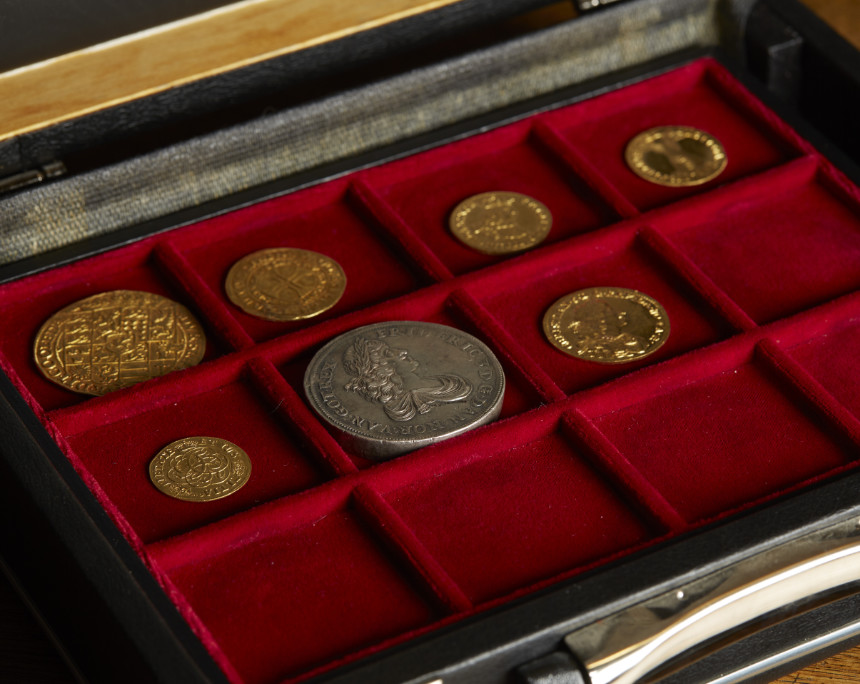
Estimate: 6.000 EURDenmark,
Frederik IV.
Double-Ducat 1704, Copenhagen.
With certificate of authenticity.
Condition: ef-
681
Estimate: 1.000 EURIreland,
George III.
6 Shilling Token 1804.
Condition: PL
805
Estimate: 1.000 EURNetherlands,
Friesland.
Adler-Taler 1598.
Condition: Very rare, vf
886
Estimate: 2.000 EURSinzendorf,
Johann Wilhelm.
Ducat 1753, Nuremberg.
Condition: rare, lightly worked, vf-
1165
Estimate: 2.000 EURPomerania-Stettin,
Bogislaus XIV.
Taler 1629.
Condition: very rare, very fine details, vf+.
1385
Estimate: 1.200 EURReuss,
younger line,
Heinrich XIV.
2 Mark 1884 A.
Condition: unc-
2059
Estimate: 12.500 EURDependencies, Danzig.
25 Gulden 1923.
Condition: PCGS PR62
2681

Archive: People and Markets
Tiffany Art Metropolis – Palace of Westminster

CIT’s Tiffany issues are among the most coveted rarities on the collectors’ market. This is not only due to their innovative inlay but also to the high level of minting technology and the attention to detail. In 2023 it is London’s turn with the Palace of Westminster. The playful neo-Gothic architecture of the Victorian age is perfectly suited for such an elaborate design.

Goetz-Ulf Jungmichel Elected as Associate Member of the Board of the Berufsverband des Deutschen Münzenfachhandels e.V

The Berufsverband des Deutschen Münzfachhandels e.V. recently held its board elections and made important personnel decisions.

New Publication on Hallmarks of Gold Coinage in Serbia and Yugoslavia

After the work of countless renowned scholars, is it even possible to make new findings in the numismatics of Austria-Hungary and the Balkans? The Austrian Research Society for Numismatics says „yes!“ and proves this with Aleksandar Brzić’s new book on Serbian and Yugoslav hallmarks on gold coins from 1882 to 1941.

Freshly unearthed silver coins – denarii of the Bohemian princes from the turn of the 11th to the 12th century. Photo: Institute of Archaeology of the Czech Academy of Sciences in Prague.

More Than 2,000 Medieval Denarii Discovered in Czechia

It is said to be one of the most important Czech coin hoards of the last 10 years: more than 2,000 coins from the period around 1100 have been discovered near Kutná Hora. The find dates from a time of conflict between members of the Přemyslid dynasty for control of the Prague princely throne.

Archive: Coins, Medals and more

Gaius Iulius Vindex. Denar, zwischen März und Mai 68, Vienne(?). Äußerst selten. Vorzüglich. Taxe: 1.500 Euro. Aus Auktion Heidelberger Münzhandlung 89 (12. November 2024), Nr. 113. Hintergrund: Büste Neros, im Kapitolnischen Museum in Rom (cjh1452000 - CC BY-SA 3.0) und Büste Galbas im Stockholmer Schloss (Wolfgang Sauber / CC BY-SA 3.0).

The Roman Civil War of 68/9: The Prelude to the Year of the Four Emperors

Heidelberger Münzhandlung will offer a series of coins of impeccable quality struck during the Roman Civil War at its auction on 12 and 13 November 2024. We take advantage of this opportunity to examine the historical background of these issues, going back to a time when counter-emperors did not (yet) dare to put their portrait on coins.
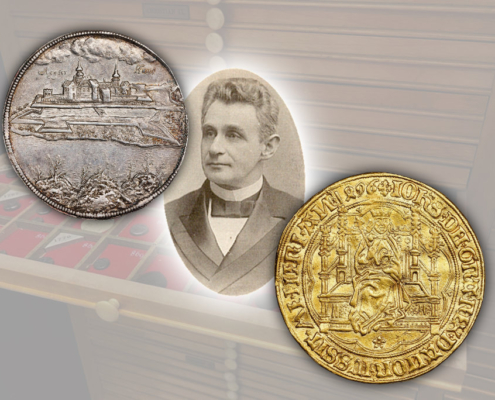
Karl Ludwig von Bruck, the mastermind behind the Vienna Coinage Treaty. We chose not to depict Emperor Franz Josef I at this point, who is shown on the coins, but the liberal politician Karl Ludwig von Bruck. Born into the family of a bookbinder in Elberfeld (now Wuppertal, Germany), he worked his way up from a merchant’s position to become Austria’s finance minister. He could almost be described as a beacon of hope for Austrian economic policy. It was tragic – and not just for him personally – that Franz Josef “ungraciously” dismissed him in April 1860 on false suspicions. The then 61-year-old took his own life. This deprived Austria of an imaginative politician who might have prevented its economic marginalization by Prussia.

A War Fought with Unusual Weapons: How Prussia Used Finance and Politics to Force the Habsburg Hereditary Lands Out of the German Confederation

On 26 March 2024, the Künker auction house will offer the Tursky Collection with coins of Emperor Franz Joseph I. We use specimens from this collection to tell the story of how Prussia used its economic sway to become the sole hegemonic power in Germany.
Search Search