154Prussia. Frederick William IV, 1840–1861.
Gold medal in the weight of 50 ducats
commemorating the publication of the second volume
of Alexander von Humboldt’s *Kosmos*.
NGC MS 65 PL.
From the estate of Emperor William I.
Estimate: 40.000 Euro

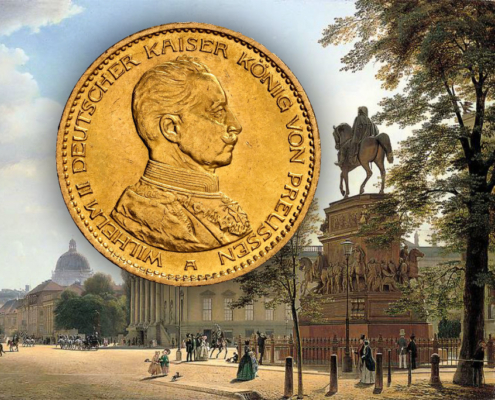
166Prussia. Frederick William IV, 1840–1861.
Gold medal in the weight of 50 ducats commemorating
the unveiling of the equestrian statue of
Frederick the Great on Unter den Linden in Berlin in 1851.
NGC MS 63 PL.
From the estate of Emperor William I.
Estimate: 25.000 Euro

191Prussia. William I, 1861–1888.
General’s Medal in the weight of 120 ducats, 1871,
commemorating the victory over France.
A magnificent specimen.
From the estate of Emperor William I.
Estimate: 75.000 Euro

297Russia. Nicholas I, 1825–1855. Family ruble.
1 1/2 rubles (10 zlotys), 1835, St. Petersburg.
NGC MS 64 (Top Pop).
Only 36 examples struck.
A cabinet piece from polished dies.
From the estate of King Frederick William IV.
Estimate: 250.000 Euro

1098Holland. Province.
5 ducats, 1681.
Struck with the dies of a guilder.
NGC PF 64 Cameo.
Proof.
Estimate: 40.000 Euro

1192HRE. Ferdinand II, 1592–1618–1637.
5 ducats, 1634, Vienna.
Extremely rare.
Extremely fine-uncirculated.
Estimate: 10.000 Euro

1266HRE. Vienna.
Salvator Medal in the weight of 12 ducats,
n. d.(around 1840).
NGC PF 61 CAMEO.
Proof.
Estimate: 15.000 Euro

1334City of Regensburg.
5 ducats, n. d. (1708–1710),
with the title of Joseph I. NGC MS 64.
Extremely rare. According to mint records,
only 7 copies struck.
A magnificent piece.
Estimate: 25.000 Euro

1602German New Guinea.
10 New Guinea Marks, 1895 A.
NGC MS 65.
A magnificent piece.
Estimate: 50.000 Euro

2757Saxony.
John Frederick the Magnanimous and
Maurice, 1541–1547.
Trinity Medal, 1544.
A masterpiece of German medal art. Magnificent,
excellent craftsmanship.
Estimate: 75.000 Euro

Archive: People and Markets
NYINC: The Favourite of All Those Who Love Ancient Coins

Why is the New York International Numismatic Convention the top place to go when it comes to ancient coins? Ursula Kampmann has the answer and explains what will be new and different in New York in 2024.

Trump’s Influence? United States Mint Removes Commemorative Medal from Store

The United States Mint has removed a commemorative medal honouring the police officers who defended the Capitol during the attack on 6 January 2021 from its website, sparking criticism.

World Money Fair ‘Minting Experience Centre’: Minting up Close!

The organizers of the World Money Fair have come up with something special for the upcoming event. The new Minting Experience Center that spans over 100 square meters showcases the production steps involved in minting coins. Guests will even have the chance to mint their own World Money Fair collector’s medal.

Ursula Kampmann: Die Briefe des Herrn von Schellenberg an Johann Jakob Rüeger. Ein entlarvendes Selbstzeugnis vom Niedergang eines gebildeten Reichsritters und Münzsammlers. Bd. I: Die Briefe. (Nomismata, 13.1), Habelt Verlag 2023. 576 S., 29 cm. ISBN 978-3-7749-4378-0. Preis: 89 €.

Collecting Coins Around 1600

In January 2024, the first volume of Ursula Kampmann’s three-part work on the letters of Hans von Schellenberg was published. The author presents one of the most insightful sources on collecting coins in the early modern period in its historical context.

Archive: Coins, Medals and more

Women on Commemorative Coins: A Long Road to True Equality

Every year, International Women’s Day is celebrated on 8 March—and this week, numismatists also have a reason to celebrate. On 6 March, a German 20-euro coin was issued to mark the 50th anniversary of the International Women’s Year. This coin marks the beginning of a new German commemorative coin series under the theme "Influential Women". But does this mean that women have finally secured their place in the world of numismatics?

The Suffering of Leiden – A Siege During the Dutch Revolt

The third part of the Beuth Collection that Künker offers in Auction 420 contains many historically interesting emergency and siege coins. They were issued by the Dutch towns besieged by Spain during the 80 Years' War. One of these towns was Leiden, which to this day commemorates the end of the siege every year with a festival.
Search Search