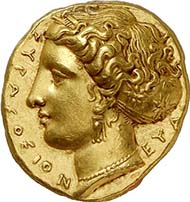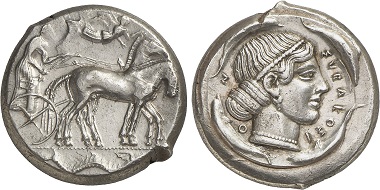
80,000 Euros for a work of two Sicilian die cutters

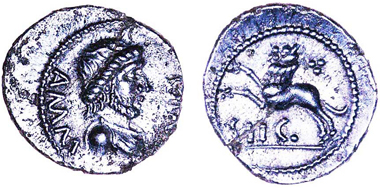
For an impressive amount of money some extraordinary Greek coins were auctioned at Gorny & Mosch’s, Giessener Münzhandlung on October 10. One of them is a remarkable tetradrachm from Syracuse whose story you will read here…

Was king of east Kent son of badger killer?

On 20 December 2012 an exceedingly rare gold coin of the Cantiaci tribe was found south of Canterbury in Kent. The coin is a gold quarter stater attributed to Sego, an elusive king who probably ruled in east Kent shortly after the birth of Christ.

The Punic Goddess

On Friday, March 13, 2015, Künker auctions off a Siculo-Punic coin with an enigmatic depiction: on the obverse we see a beautiful woman with a Phrygian cap. Is it Dido? Is it Tanit? Or is it perhaps a completely different goddess?

Greek mercenaries in Persian service

In auction 304, the Osnabrück auction house Künker offers a series of early Persian coins showing portraits of kings and satraps, including four of the enigmatic tetradrachms of Athenian type with small portraits or Aramaic lettering. They are likely to have been produced under Persian orders for paying Greek mercenaries.

Heracles the snake-strangler

Herakles strangling the snakes, this subject occurs on the coins of some very important harbor towns of Asia Minor at the same time. This article will explain what’s behind it…

Jersey – the Treasure Island of Celtic Coins

Jersey Post has just issued stamps featuring six iron age coins from a hoard found at Le Catillon, Jersey, in 1957. Celtic coin expert Chris Rudd reveals how it comes that Jersey may truly be called Treasure Island of iron age coins…

The ‘Modest Aphrodite’ from Nysa-Scythopolis (Beth Shean) and Ptolemais (Akko)

A comparison between a statue of Aphrodite found at Beth Shean and a coin type from the mint of Ptolemais reminds us of the realistic nature of statues appearing on city coins.

Documenting the Past: an Ancient Industry recorded in Coinage

An unusual coin type recently sold for 30,000 GBP at the London-based Ceres Auction House depicts an ancient industry, hitherto unrecorded on coinage or sculptural reliefs: the production of noodles.

Medieval Sicily Part 4: The Normans are coming

Around AD 1000, Sicily was ruled and shaped by the Arabs, Lower Italy by the Byzantines and the Lombards. Then the Normans came and created a new empire in the South …

A donative of Constantine the Great

This impressive piece belongs to a small series of silver medallions celebrating the vicennalia of Constantine II, the eldest surviving son of Constantine the Great, in 336.