







Joe Cribb is the 2023 Derek Allen Prize Winner
Professor Joe Cribb has been awarded the 2023 Derek Allen Prize for his outstanding contribution to the discipline of numismatics. In particular for his expertise and wide range in Asian numismatics, from the Far East via South and Southeast Asia to the Greek and later coinages of Bactria. His focus on the coinage of the Kushans and their successors, the Kushano-Sasanians and Kidarites, has led to a greatly improved understanding of the history of Afghanistan and adjacent regions in the early centuries CE.
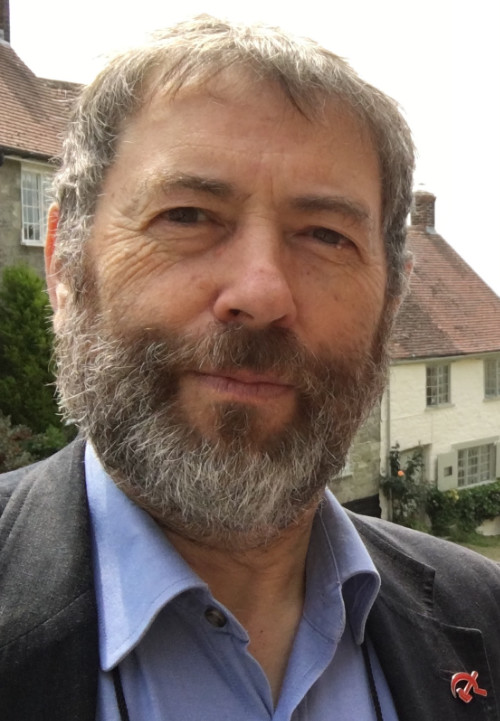
Photo: Joe Cribb.
Joe Cribb is a specialist in the monetary history of Asia. He worked as a curator of Asian currencies at the British Museum for forty years before retiring 2010 as the Head of its Department of Coins and Medals. Throughout his career he has been committed to making the Museum’s numismatic collections internationally accessible and to training young numismatists from around the world. Since his retirement he has become an adjunct professor of numismatics at Hebei Normal University, Shijiazhuang, and a trustee of the Ancient Indian and Iran Trust, Cambridge
He has authored and edited books on Chinese, Indonesian and Central and South Asian currencies and history, and introductory books on coins. He has also written many articles on Asian coins and numismatic practice. He has curated major exhibitions at the British Museum and Fitzwilliam Museum, Cambridge University. He is former President of the Royal Numismatic Society, London, and former Secretary General of the Oriental Numismatic Society.
His contributions to numismatics have been recognized by the medals of the Royal Numismatic Society, London, the American Numismatic Society, New York and the Indian Numismatic Society, Varanasi. He has also been honoured by Hebei Normal University, the Ashmolean Museum, the Institute of Silk Road Studies, Kamakura, and the Austrian Numismatic Society, Vienna.
Joe’s current research is on the Kushan dynasty in Central and South Asia, the history of numismatic research in Japan and the relationship between money and art.
He made the following comments after receiving the award in August 2023:
“I am delighted to be the recipient of the Derek Allen Prize, established in memory of one of Britain’s most important numismatic scholars. I feel honoured to be included in the list of eminent numismatic colleagues who have received this award. Numismatics is a collaborative discipline and I know that what I have achieved could not have been done without the support and friendship of many eminent scholars in this field. I can only name a few who deserve my particular thanks, my colleagues at the British Museum: Helen Wang, Elizabeth Errington, Vesta Curtis, Robert Bracey, Wannaporn Rienjang, Shailendra Bhandare, Andrew Burnett, and the late Nicholas Lowick and Martin Price, and to Dai Jianbing (Hebei Normal University), Nicholas Sims-Williams (Ancient India and Iran Trust), David Jongeward (Toronto), Gul Rahim Khan and Nasim Khan (University of Peshawar); I also have a debt of gratitude for the support of my late wife Margaret and our dear children and grandchildren and of my partner Linda Crook.
I am greatly encouraged by the receipt of this award to continue to push forward my research and to promote the importance of numismatics as a discipline, particularly for Asian history, and thank the Academy for this honour.”
The Derek Allen Prize is awarded annually in rotation for outstanding academic achievement in the fields of musicology, numismatics, and Celtic studies. Here is a list of all Derek Allen Prize winners in the field of numismatics:
2023: Professor Joe Cribb
2020: Dr. Andrew Burnett FBA, University College London
2017: Professor Michael Crawford FBA, University College London
2014: Dr. Richard Reece, University College London
2011: Dr. Mark Blackburn, Keeper, Department of Coins and Medals, Fitzwilliam Museum, Cambridge
2008: Professor Michael Metcalf, Emeritus Professor of Numismatics, University of Oxford
2005: Professor Philip Grierson FBA
2002: Professor Dr. Gert Hatz
1999: Mme Cecile Morrisson
1996: Dr. J.P.C. Kent
1993: M. Jean Lafaurie
1990: Dr. P. Bastien
1987: Dr. Georges Le Rider
1984: Dr. Simone Scheers
1981: M J.B. Colbert de Beaulieu
1978: Dr. Karel Castelin
