







An EID MAR Denarius Set a Nordic Record
An extremely precious denarius from one of the most famous assassinations in world history was sold Thursday afternoon, 15 June 2023, for a staggering EUR 570,000 (including buyer’s premium) at Bruun Rasmussen – Part of the Bonhams Network. This is the denarius that the Roman senator Brutus had minted in connection with the murder of Julius Caesar more than 2,000 years ago.
Content
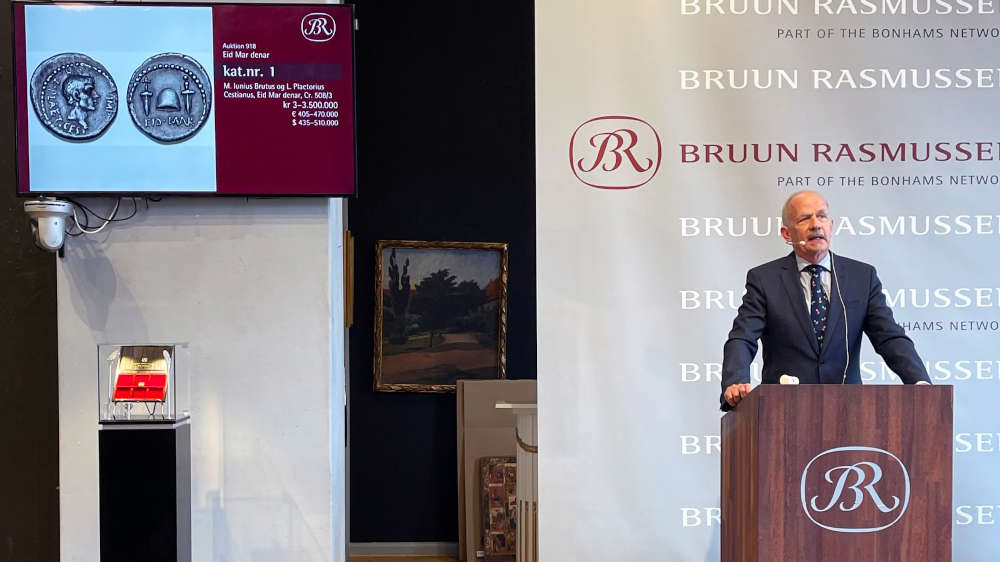
The more than 2,000-year-old denarius from the assassination of Julius Caesar in 44 BC was sold for EUR 570,000 (including buyer’s premium) at Bruun Rasmussen. Leading the sale from the podium was Chief Numismatist and auctioneer, Michael Fornitz.
There was a round of loud applause in the saleroom in Copenhagen when the legendary denarius achieved a hammer price of no less than EUR 570,000 (including buyer’s premium) at Bruun Rasmussen – Part of the Bonhams Network. The more than 2,000-year-old denarius carried with it an unusual and dramatic backstory as it was the denarius that Marcus Junius Brutus had minted in connection with the assassination of the Roman statesman Julius Caesar in 44 BC.
In addition to being extremely rare, several eminent researchers, professional numismatists and collectors have called the denarius the most significant and important of all ancient numismatic objects in world history.
Record Hammer Price
Weighing just 3.48 grams, this historical artifact may have appeared small in size, but nevertheless ended up being the most expensive numismatic object ever sold at auction in the entire Nordic region. According to Chief Numismatist, Michael Fornitz, it is also the most spectacular numismatic object he has sold at auction during his 20 years at Bruun Rasmussen – Part of the Bonhams Network.
“Since the Renaissance, this denarius has been sought after by collectors and numismatists, but due to its rarity and value it has at the same time been an unattainable object for most people. Even during the Roman Imperial period itself the denarius was famous. We are very satisfied with the sale and are delighted that we have been able to offer such a historically remarkable object that shines through millennia of human history,” says Michael Fornitz.
On the obverse side of the denarius, a right-facing portrait of Brutus can be seen. On the reverse side, a liberty cap is stamped between two daggers, symbolizing the assassination of Caesar. This is an expression of the effective propaganda that was used at the time. Written under the liberty cap is the wording “Eid Mar”, which means “15 March” – the day of the murder.

Roman Imperial Coins. Marcus Iunius Brutus and Lucius Plaetorius Cestianus. Denarius, mint travelling with Brutus and Cassius in northern Greece, late summer-autumn 42 BC. Estimate: 3.000.000–3.500.000 DKK. Price realized: 3,400,000 DKK.
“Et tu, Brute?”
Caesar did not escape his fate when he was assassinated by a large group of senators, including Marcus Junius Brutus, on 15 March in the year 44 BC. To honor himself and celebrate the bloody deed, Brutus had one of today’s most significant and telling objects of antiquity made. The denarius was an effective propaganda tool used to spread the news of Brutus’ deed throughout the Roman Empire.
Up through the centuries after Caesar’s assassination, Brutus has gained a reputation as one of the most notorious “villains” in world history, perhaps surpassed only by Judas, next to whom the Italian author Dante places Brutus in hell. Today, more than 2,000 years after the assassination of Caesar, one still sometimes hears the phrase “Et tu, Brute?” used to emphasize a sense of betrayal.
In the English-speaking world, the expression “Beware the Ides of March” has also been used since Shakespeare’s day to warn of ominous future events.
Read more about the historic denarius.
Visit the Bruun Rasmussen website.
You can read more on the EID MAR and the historical background in our article Assassins of Caesar.
An EID MAR in gold also holds our current record as Most Expensive Aureus
Have you already heard about the legal affair on the famous EID MAR aureus?
Click here to watch a video of the Greatest Coin video series on the EID MAR denarius.
