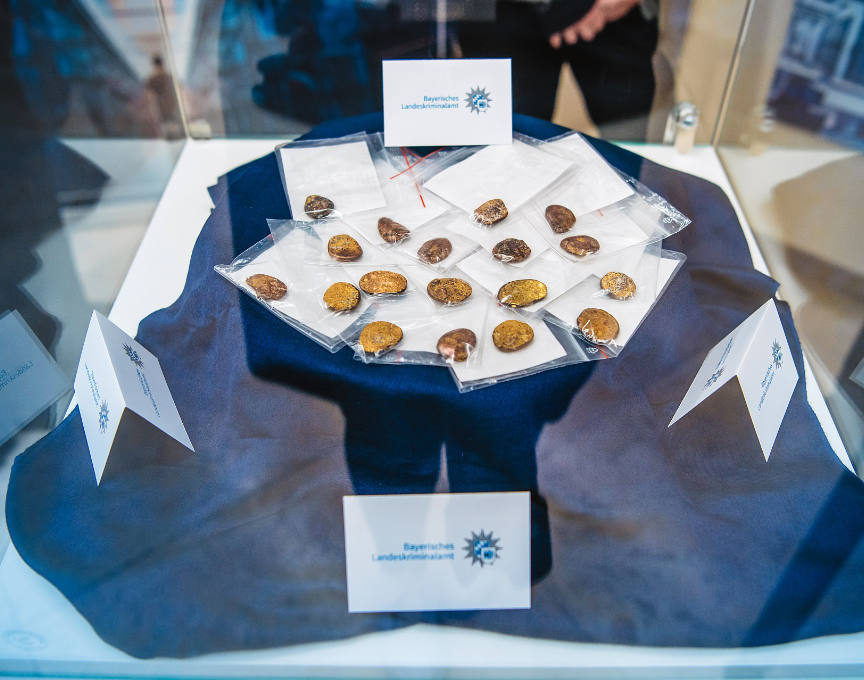
Following police success in the case of the stolen Celtic gold hoard, the authorities have made additional details public. Bavaria’s Minister of the Interior, Joachim Herrmann, praised the investigators: “It was thanks to the highly committed and meticulous work of the police and the prosecutor’s office that this professional burglar gang could be arrested.” But how did the authorities identify the suspects?
The police were quickly able to reconstruct how the criminals went about the burglary: They cut fibre optic cables, causing disruptions in the Manching area. This also interrupted the connection of the security system of the römer kelten museum manching. Therefore, the culprits could easily enter the museum, break open a showcase and steal the famous Celtic hoard containing almost 500 gold coins.
Divers Found DNA Evidence
The investigations were led by the Ingolstadt public prosecutor’s office and the Bavarian Criminal Investigation Department (CID), which assigned special art investigators to the case and installed the 25-member Oppidum special commission. When looking for clues, divers found crowbars, loppers and a cutter in a pond nearby the museum as well as – near the museum itself – a radio aerial. The forensics team was able to secure DNA evidence.
Data Matching and Reviewing Files
The DNA sample generated eight hits in databases for burglaries with a similar pattern. Since 2014, several burglaries have occurred in Germany and Austria in which perpetrators wore black coveralls and balaclavas, and had previously cut fibre optic cables. In these crimes in Nienhagen, Pressath, Edermünde, Winsen, Bad Aibling, Heilsbronn and Schwarzheide (Germany) as well as Krems (Austria), similar crowbars, screwdrivers and an angle grinder were used. With a radar jamming transmitter, the criminals were able to disrupt alarm systems.
The special commission compared this procedure to files of similar crimes. In the process, a 42-year-old German from Schwerin caught the investigators’ attention. He is suspected of having been involved in a burglary in North Rhine-Westphalia in 2018. Through this suspect, the special commission identified a 46-year-old German. Further investigations, which are now supported by the CID of Mecklenburg-Vorpommern, substantiated the suspicions against both men as well as a 50-year-old German who also lives in Schwerin.
Arresting the Criminals and Charging Them
On 18 July 2023, the 46-year-old met another man from Berlin, who the police consider to be another member of the criminal gang. Immediately afterwards, the police simultaneously intervened in Ludwigslust-Parchim, Schwerin and Halle (Westphalia) and took the four suspects into temporary custody.
The Ingolstadt prosecutor’s office accuses the defendants of aggravated gang theft concomitantly with criminal damage to objects of public interest and disruption of telecommunication systems.
What Evidence Was Found with the Accused?
According to the press release, the investigators searched “28 flats, business premises, garden plots, a boathouse, and vehicles”. They found “coveralls, masks, burglary tools, backpacks, cell phones, jammers, and cash”. Moreover, the 43-year-old “was in possession of a plastic bag with 18 gold lumps in it. An initial micro x-ray fluorescence analysis carried out by the forensic institute of the Bavarian CID revealed a mixture of gold, silver and copper that corresponds to the composition of the gold hoard. Therefore, it must be assumed that these lumps were produced by melting down the Manching gold hoard. The pieces are currently being analysed in cooperation with the Archaeological State Collection.”
Herrmann, the Minister of the Interior, explained: “The investigations into the whereabouts of the gold treasure are continuing at full speed.” The Oppidum special commission will further investigate the matter.