






G+D Receives IACA Award for the “Green Banknote”
The IACA Excellence in Currency Award is presented by the International Association of Currency Affairs for the best new environmental sustainability project in the banknote sector. Giesecke+Devrient (G+D) has now been honored with this award for its “Green Banknote”.
Content
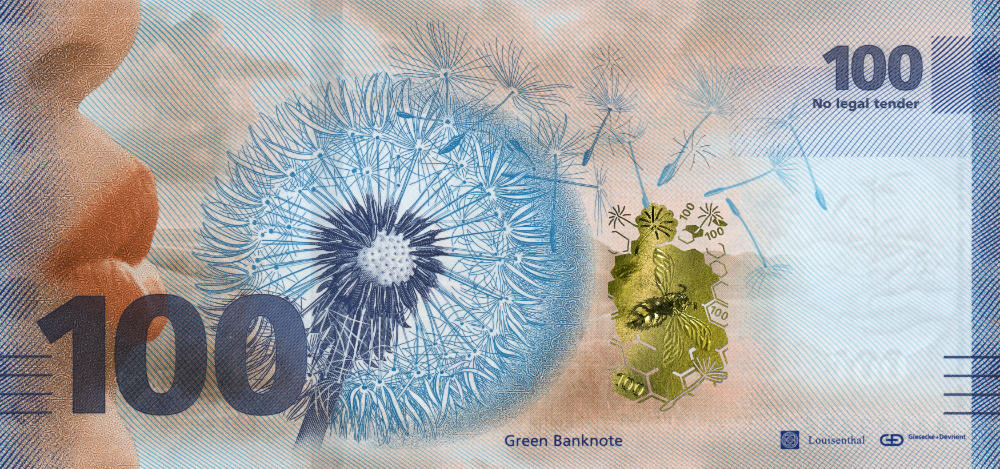
Environmental compatibility and sustainability are also playing an increasingly important role in money production. The “Green Banknote” from Giesecke+Devrient contains 86% less plastic and requires 29% less Co2.
The IACA Awards
The International Association of Currency Affairs (IACA) is one of the largest associations in the payments sector and presents industry awards in different categories including sustainable environmental projects. At the Currency Conference in Mexico, G+D has been awarded the IACA Excellence in Currency Award for its “Green Banknote”. The new banknote, developed with environmental considerations in mind, was introduced by G+D in 2022 and received with great acclaim worldwide. Several countries have already placed orders for the Green Banknote this year.
What is the “Green Banknote”?
The “Green Banknote” combines several innovative technological measures to significantly reduce the ecological footprint in the production and use of banknotes in the cash cycle. For example, natural, certified fibers are utilized in a sustainable production process. The organic cotton used requires neither synthetic fertilizers nor pesticides and the FSC® (FSC-C138716) certified wood pulp comes exclusively from sustainably managed European forestry. This material mix reduces the CO2 footprint of the paper core by 63 percent and the plastic content in the Green Banknote’s Hybrid substrate is 86 percent less compared to polymer banknotes. The lamination film is reduced by a third from 6 µm to 4 µm and the carrier foil for security threads and foils consists of 70 percent recycled PET. Additionally for the first time, mineral oil-free ink is used for banknote printing. At the same time, the “Green Banknote” is very durable. The longer they remain fit and clean in circulation, the fewer new banknotes need to be produced.
“With the “Green Banknote” we are setting an example for a sustainable currency cycle optimized from an ecological point of view,” explains Bernd Kümmerle, Managing Director of the Banknote Solutions Division at G+D Currency Technology. “The IACA Excellence in Currency Award confirms our sustainability commitment and the future orientation of our solutions. We see it as an incentive for the continuous further development of environmentally friendly payment solutions.”
