






Panticapaeum Stater Most Expensive Ancient Coin
A gold stater from the city of Panticapaeum, in present-day Crimea, has become the most expensive ancient coin ever sold at auction.
Content
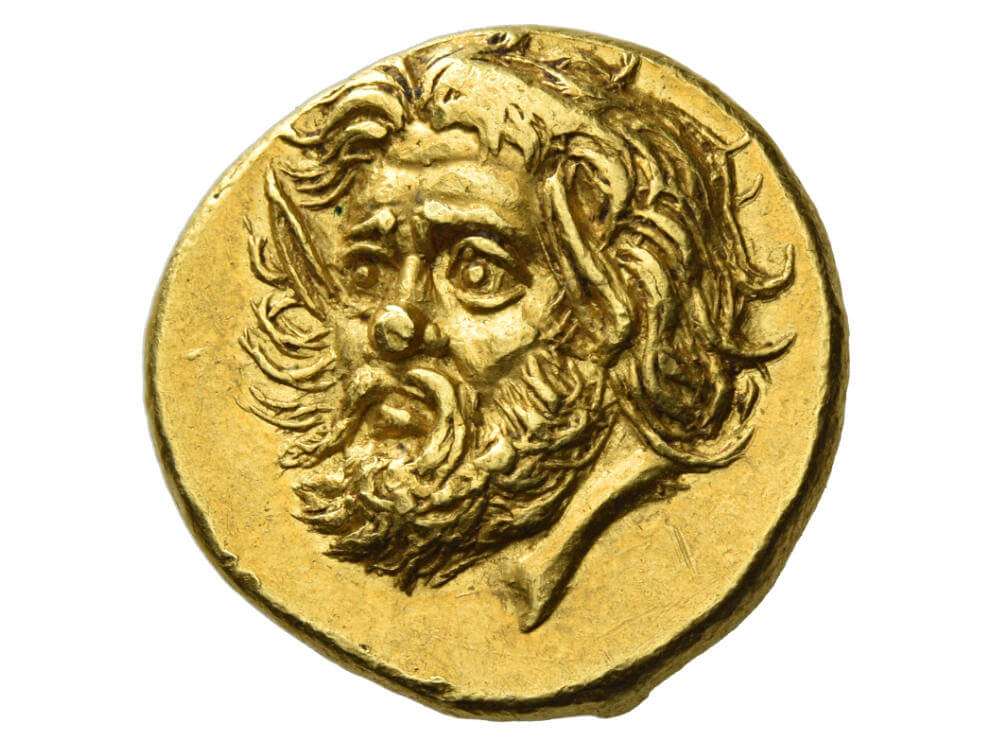
This Panticapaeum stater was minted in the 4th century on the Crimea and was sold by auction house NAC in May 2023 for 5,390,000 CHF. Image courtesy of Numismatica Ars Classica.
5,390,000 CHF For a Panticapaeum Stater
Sold by rare coin dealer Numismatica Ars Classica at an auction in Switzerland, the coin reached a record 5,390,000 CHF (equivalent to approximately $6 million). The record sale has been attributed to the coin’s rarity and extraordinary beauty. This is probably the only specimen of this issue in private hands, as all other known specimens are held in museum collections.
The coin was formerly part of the collection of the Hermitage Museum in St. Petersburg. It was sold in an auction of the museum’s duplicates in 1934, when Stalin decided to sell works of art in order to raise foreign currency to finance the Soviet government’s plans for industrial growth. The coin then moved into the most important private collection of Greek coins ever assembled: the Charles Gillet collection. Gillet (1879-1972) was a French industrialist who amassed a remarkable collection of books, antiquities, furniture and coins.
The coin is viewed as one of the most important and desirable coins of the entire Greek World. It features a beautiful engraving of a head of a satyr on its obverse side, and a griffin with a spear in its mouth on the reverse. The satyr is thought to be a punning reference to the Spartocid king Satyros I, whilst the griffin alludes to the griffins believed to guard the gold found in the mountains of Scythia. With extraordinary detail, the coin is clearly the work of a master engraver.
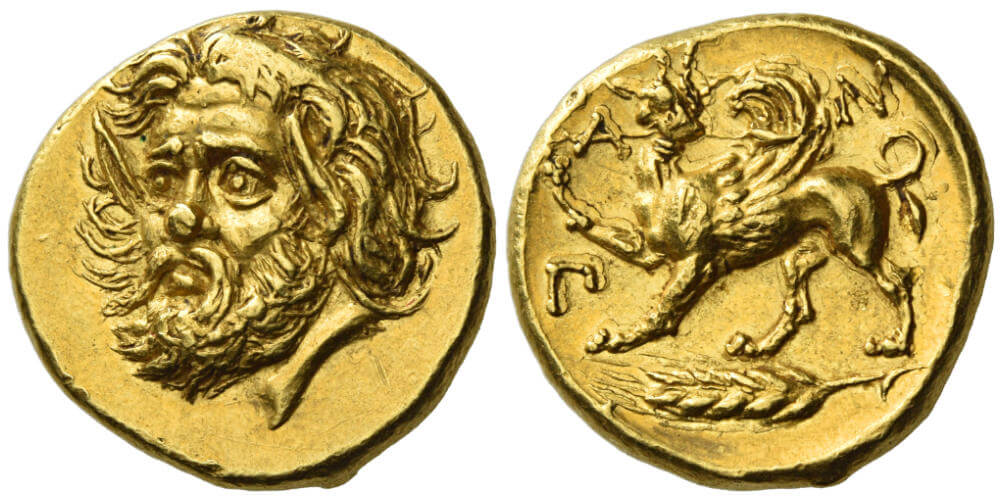
This Panticapaeum stater was sold in 1934 by the Hermitage Museum in St. Petersburg. Image courtesy of Numismatica Ars Classica.
What Makes the Panticapaeum Stater the Most Expensive Ancient Coin Ever?
On staters of Panticapaeum, the head of the satyr is typically always depicted in profile facing left, except for this one extremely rare issue for which the engraver decided to break with custom and depict the satyr facing three-quarters left. He may have been inspired to attempt this artistically difficult new treatment of the head under the influence of a wider fashion for three-quarter facing heads on Greek coins that developed at the end of the fifth and in the early fourth century BC.
Politician and rare coin collector Godfrey Locker-Lampson wrote of this issue: “That so much expression could be packed into so small a round would not be believed by anyone who had not seen it. If a single coin had to be selected from those described in these pages, as by the greatest of all die-engravers, whoever he may have been, whose work had lasted to the present day, the writer would choose this one.”
Arturo Russo, Co-Director of Numismatica Ars Classica, said: “I am extremely pleased with the phenomenal result the sale of the Panticapaeum stater achieved at our latest auction in Zurich. The whole auction realised exceptionally high prices totalling over 21 million CHF, well exceeding a presale estimate of 11 million CHF. This is a sign the whole market for numismatics is flourishing, and is especially strong for ancients at the moment.”
