







Successful Launch of the 11-Euro Football Coin for the 2024 European Championship
by Sebastian Wieschowski, translated by Maike Meßmann
What happened on 8 May in front of Bundesbank branches across Germany has rarely been seen in recent years: hundreds of people took the opportunity to get their hands on one (or more) of the 11-euro coins commemorating the EURO 2024 football championship. The launch of this issue caused a sensation, not only because of its unusual denomination, but also because of the wide-ranging discussions it had sparked in the run-up to this day. After all, this is the first time in the history of the Federal Republic of Germany that a commemorative coin that is not intended for circulation will be issued with an “odd” face value (i.e. one that cannot be divided by 5 or 10).
Content
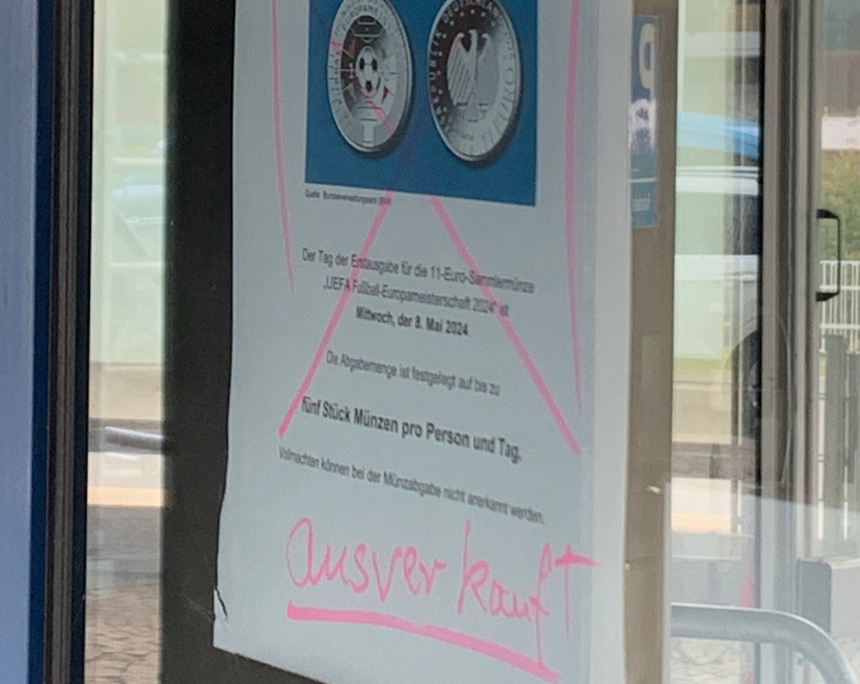
A rare sight: a notice at the entrance to the Bundesbank branch in Ludwigshafen, stating that the 11-euro football coin is sold out. Photo: Wieschowski
Long Queues at Bundesbank Branches
The reports from various cities where Bundesbank branches had the new commemorative coins in stock are quite similar: several hundred people formed long queues, and in some offices, the new coins sold out on the very first day: “Long queues in front of the Bundesbank in Rostock,” read a headline in the local Ostsee-Zeitung newspaper. And “11-euro special coin for the Euro 2024: queues in Hanover,” reported the channel “Sat1 Regional”. The local TV broadcaster gave numerous collectors a chance to speak – and random street surveys showed just how much general interest there is in the football coin: “We are seven or eight collector friends. We also have two daughters who have children that already collect, and then there are our friends who all want the coin too,” said a collector called Bruno.
Some Try to Buy More Than the Permitted Amount
In Hannover – and in most other Bundesbank branches – collector were allowed to purchase five coins a day; but according to the “Sat1 Regional” report, many people took advantage of this rule to buy as many of the coveted collectibles as possible. This is why such days are also something special for Bundesbank employees: “The face value in particular is very special. We have an 11-euro coin, which is very unusual considering that coins are usually issued in denominations of 5 euros, 10 euros, and so on,” explains Dirk Gerlach, head of the Bundesbank’s Hannover branch. He comments: “There are a total of one million of these special coins, which is not very many given Germany’s population. So some people try to buy more than the permitted amount. It can happen that someone who has just left the counter goes straight back to join the end of the queue.”
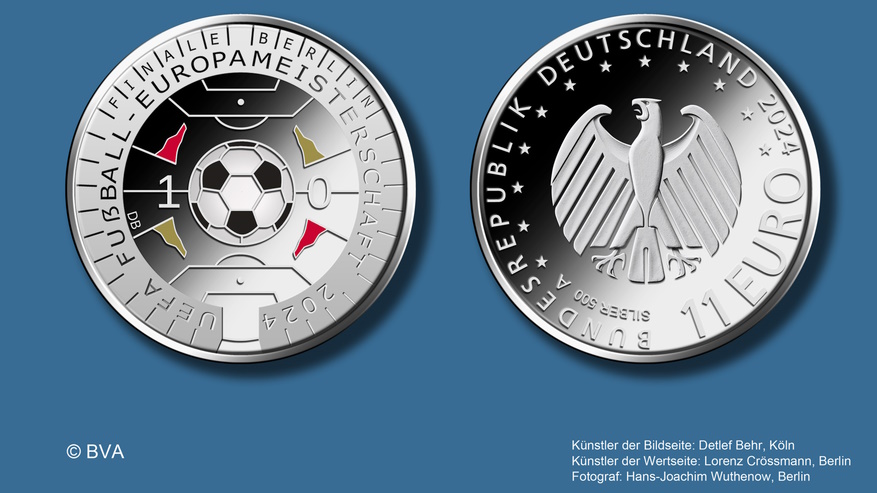
The object of desire: the first German commemorative coin with an “odd” denomination. Photo: Federal Ministry of Finance
Initial Criticism Has Given Way to Euphoria
The announcement of the football coin was initially met with mixed feelings by the collector community in Germany. Many considered the face value of eleven euros to be nothing more than a gimmick, and the coin’s alloy (500/1000 silver) was also criticised. However, by the day of issue at the latest, the backlash had died down – the rush in cities like Hamburg and Hannover brought to mind memories of the launch of the 5-euro polymer coins in 2016.
The rush for the first 11-euro coin of the Federal Republic of Germany is quite surprising: while previous issues, such as 2-euro coins or colour coins, attracted only limited interest, the 11-euro coin seems to have appealed to collectors of all ages. This can partly be explained by the growing interest in numismatic rarities and the coin’s special connection with football, a highly popular sport in Germany.
A Coin as a Souvenir for Fans from All Over Europe?
Enthusiasm for the 11- euro football coin is likely to grow even further, especially if the German team does well in the European Championship. It remains to be seen whether a coin of all things will become a sought-after souvenir, arousing interest not only among football fans but also among tourists and collectors from other countries. And perhaps this success will give its designers at the Federal Ministry of Finance an extra boost for further numismatic experiments.
