154Prussia. Frederick William IV, 1840–1861.
Gold medal in the weight of 50 ducats
commemorating the publication of the second volume
of Alexander von Humboldt’s *Kosmos*.
NGC MS 65 PL.
From the estate of Emperor William I.
Estimate: 40.000 Euro

166Prussia. Frederick William IV, 1840–1861.
Gold medal in the weight of 50 ducats commemorating
the unveiling of the equestrian statue of
Frederick the Great on Unter den Linden in Berlin in 1851.
NGC MS 63 PL.
From the estate of Emperor William I.
Estimate: 25.000 Euro

191Prussia. William I, 1861–1888.
General’s Medal in the weight of 120 ducats, 1871,
commemorating the victory over France.
A magnificent specimen.
From the estate of Emperor William I.
Estimate: 75.000 Euro

297Russia. Nicholas I, 1825–1855. Family ruble.
1 1/2 rubles (10 zlotys), 1835, St. Petersburg.
NGC MS 64 (Top Pop).
Only 36 examples struck.
A cabinet piece from polished dies.
From the estate of King Frederick William IV.
Estimate: 250.000 Euro

1098Holland. Province.
5 ducats, 1681.
Struck with the dies of a guilder.
NGC PF 64 Cameo.
Proof.
Estimate: 40.000 Euro

1192HRE. Ferdinand II, 1592–1618–1637.
5 ducats, 1634, Vienna.
Extremely rare.
Extremely fine-uncirculated.
Estimate: 10.000 Euro

1266HRE. Vienna.
Salvator Medal in the weight of 12 ducats,
n. d.(around 1840).
NGC PF 61 CAMEO.
Proof.
Estimate: 15.000 Euro

1334City of Regensburg.
5 ducats, n. d. (1708–1710),
with the title of Joseph I. NGC MS 64.
Extremely rare. According to mint records,
only 7 copies struck.
A magnificent piece.
Estimate: 25.000 Euro

1602German New Guinea.
10 New Guinea Marks, 1895 A.
NGC MS 65.
A magnificent piece.
Estimate: 50.000 Euro

2757Saxony.
John Frederick the Magnanimous and
Maurice, 1541–1547.
Trinity Medal, 1544.
A masterpiece of German medal art. Magnificent,
excellent craftsmanship.
Estimate: 75.000 Euro

Archive: People and Markets
From a Collector’s Market to an Investor’s Market: Reasons, Consequences, Opportunities, Part 1

Complaining is of no use: change is coming, or may already be here. The question is how to deal with it. In order to develop smart strategies, one must be aware of what is actually happening and why. Ursula Kampmann summarizes the most important changes in the coin world in a loose series. Today: the shift from a collector to an investor market.

Ephesus Experience Museum – Symphony on a World Heritage Site

Visitors to the ruins of ancient Ephesus will now find an additional museum on the site. The focus here is not on originals, but on atmospheric installations and technical projections of the highest standard. The experience was created by Atelier Brückner.

Coins of the Islamic Lands From the Nasser D. Khalili Collection

The Khalili Collection of Islamic Art is one of the most comprehensive of its kind, and its Islamic coinage is among the finest in private hands. A catalog featuring highlights from the early period of Islamic Coinage has now been published, including many rare and unpublished specimens.

Photo: Sebastian Wieschowski

German Collector Coins – Where Are the Collectors?

Every few months, Germany’s latest collector coins can be bought at face value at the counters of the Bundesbank. Sebastian Wieschowski has been on site as a collector and roving reporter for many years. He wonders: why do fewer and fewer coin enthusiasts want to be there when new additions to their own collections are being released?

Archive: Coins, Medals and more

Karl Ludwig von Bruck, the mastermind behind the Vienna Coinage Treaty. We chose not to depict Emperor Franz Josef I at this point, who is shown on the coins, but the liberal politician Karl Ludwig von Bruck. Born into the family of a bookbinder in Elberfeld (now Wuppertal, Germany), he worked his way up from a merchant’s position to become Austria’s finance minister. He could almost be described as a beacon of hope for Austrian economic policy. It was tragic – and not just for him personally – that Franz Josef “ungraciously” dismissed him in April 1860 on false suspicions. The then 61-year-old took his own life. This deprived Austria of an imaginative politician who might have prevented its economic marginalization by Prussia.

A War Fought with Unusual Weapons: How Prussia Used Finance and Politics to Force the Habsburg Hereditary Lands Out of the German Confederation

On 26 March 2024, the Künker auction house will offer the Tursky Collection with coins of Emperor Franz Joseph I. We use specimens from this collection to tell the story of how Prussia used its economic sway to become the sole hegemonic power in Germany.
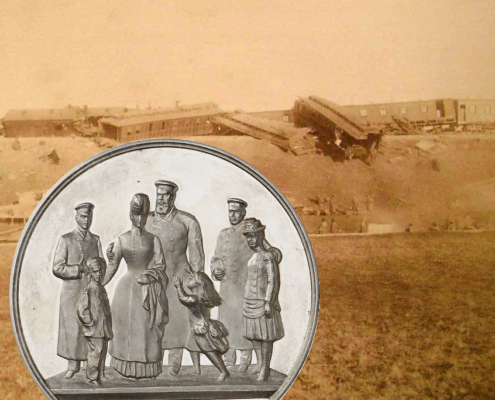
On 29 October 1888, the Russian imperial train derailed near the village of Borki. 23 people lost their lives. The tsar’s family survived. A medal commemorates the event. It will be offered by the Künker auction house on 1 February 2024.

The Borki Train Disaster

On 29 October 1888, the Russian imperial train derailed near the village of Borki. 23 people lost their lives. The tsar’s family survived. A medal commemorates the event. It will be offered by the Künker auction house on 1 February 2024.
Search Search