






Archive: People and Markets

How the Romans Made Counterfeits
Counterfeits have been around in ancient Roman times, too – usually, they were cast from a copper-tin alloy. Researchers at the University of Tübingen examined the counterfeiting process and reconstructed it experimentally. A video documents their experiment.
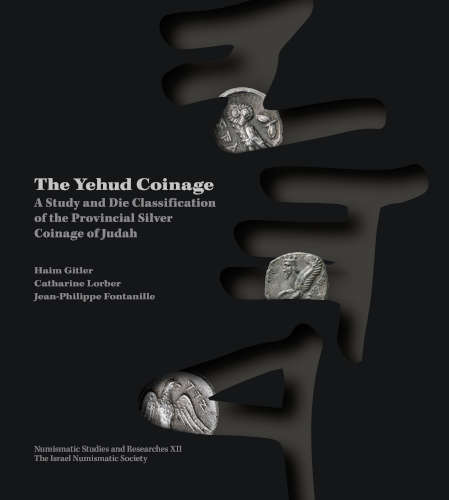
Die Study of the Yehud Coinage
The Israel Numismatic Society published a book on provincial silver coinage of Judah in the late Persian, Macedonian, and early Hellenistic periods. Haim Gitler, Catharine Lorber and Jean-Philippe Fontanille presented their die study recently in Jerusalem.
Archive: Coins, Medals and more
 https://new.coinsweekly.com/wp-content/uploads/2023/11/2023KW46HA_00.jpg
684
860
Ursula Kampmann
https://new.coinsweekly.com/wp-content/uploads/2023/01/logo-coinsweekly_590x204.png
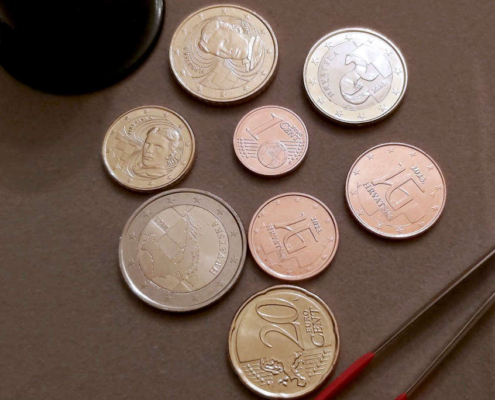
Ursula Kampmann2023-11-16 09:14:582023-11-16 09:23:58The First Error Coins from Croatia
https://new.coinsweekly.com/wp-content/uploads/2023/11/2023KW46HA_00.jpg
684
860
Ursula Kampmann
https://new.coinsweekly.com/wp-content/uploads/2023/01/logo-coinsweekly_590x204.png
Ursula Kampmann2023-11-16 09:14:582023-11-16 09:23:58The First Error Coins from Croatia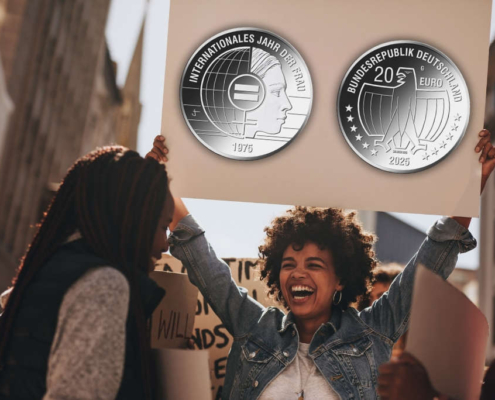 https://new.coinsweekly.com/wp-content/uploads/2025/03/0.jpg
684
860
Sebastian Wieschowski
https://new.coinsweekly.com/wp-content/uploads/2023/01/logo-coinsweekly_590x204.png
Sebastian Wieschowski2025-03-06 06:00:312025-03-06 14:32:55Women on Commemorative Coins: A Long Road to True Equality
https://new.coinsweekly.com/wp-content/uploads/2025/03/0.jpg
684
860
Sebastian Wieschowski
https://new.coinsweekly.com/wp-content/uploads/2023/01/logo-coinsweekly_590x204.png
Sebastian Wieschowski2025-03-06 06:00:312025-03-06 14:32:55Women on Commemorative Coins: A Long Road to True Equality
Provenanced Coin Finds Versus Rarities – The Importance of Coin Finds for Historical Statistics
Reporting coin finds is essential for the study of coinage. A Workshop in Jordan discussed the importance of coin finds for historical statistics and the experience of a group of Syrian archaeologists who turned to one of the most important groups of coin finders: children.
How Two Fraudsters Almost Changed England’s History
Two English metal detectorists attempted to sell off some illegally excavated coins. In a police operation straight out of a movie, the pair were caught and have now been sentenced. The seized coins present England’s King Alfred the Great in a totally different light.