154Prussia. Frederick William IV, 1840–1861.
Gold medal in the weight of 50 ducats
commemorating the publication of the second volume
of Alexander von Humboldt’s *Kosmos*.
NGC MS 65 PL.
From the estate of Emperor William I.
Estimate: 40.000 Euro

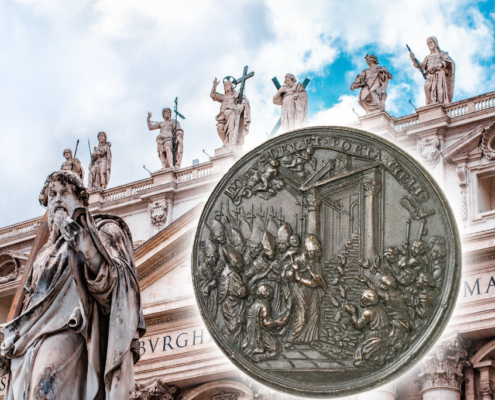
166Prussia. Frederick William IV, 1840–1861.
Gold medal in the weight of 50 ducats commemorating
the unveiling of the equestrian statue of
Frederick the Great on Unter den Linden in Berlin in 1851.
NGC MS 63 PL.
From the estate of Emperor William I.
Estimate: 25.000 Euro

191Prussia. William I, 1861–1888.
General’s Medal in the weight of 120 ducats, 1871,
commemorating the victory over France.
A magnificent specimen.
From the estate of Emperor William I.
Estimate: 75.000 Euro

297Russia. Nicholas I, 1825–1855. Family ruble.
1 1/2 rubles (10 zlotys), 1835, St. Petersburg.
NGC MS 64 (Top Pop).
Only 36 examples struck.
A cabinet piece from polished dies.
From the estate of King Frederick William IV.
Estimate: 250.000 Euro

1098Holland. Province.
5 ducats, 1681.
Struck with the dies of a guilder.
NGC PF 64 Cameo.
Proof.
Estimate: 40.000 Euro

1192HRE. Ferdinand II, 1592–1618–1637.
5 ducats, 1634, Vienna.
Extremely rare.
Extremely fine-uncirculated.
Estimate: 10.000 Euro

1266HRE. Vienna.
Salvator Medal in the weight of 12 ducats,
n. d.(around 1840).
NGC PF 61 CAMEO.
Proof.
Estimate: 15.000 Euro

1334City of Regensburg.
5 ducats, n. d. (1708–1710),
with the title of Joseph I. NGC MS 64.
Extremely rare. According to mint records,
only 7 copies struck.
A magnificent piece.
Estimate: 25.000 Euro

1602German New Guinea.
10 New Guinea Marks, 1895 A.
NGC MS 65.
A magnificent piece.
Estimate: 50.000 Euro

2757Saxony.
John Frederick the Magnanimous and
Maurice, 1541–1547.
Trinity Medal, 1544.
A masterpiece of German medal art. Magnificent,
excellent craftsmanship.
Estimate: 75.000 Euro

Archive: People and Markets
Stack’s Bowers Galleries Professional Numismatist Program

If you have ever considered making your hobby your profession and aren’t older than 25 years, the Stack’s Bowers Professional Numismatist Program offers an opportunity to acquire the skills necessary to be successful in this field.

Tradition Meets Craftsmanship: Coin Minting as a Highlight of the Garden Show

When the Garden Show in Freudenstadt and Baiersbronn opens its doors in May, visitors can look forward to a special experience: a historical minting station, where they can create their own commemorative medals by hand.

The German grading capital: The Certified Collectibles Group has its European headquarters for the grading of coins and banknotes in Munich. Photo: Annet Debar / Canva Pro.

PMG Now Grading Banknotes Year-round in Munich

The introduction of full-time PMG grading services in Munich, initially available for the Bulk and Modern tiers, marks a new expansion of the company’s services for the paper money collecting community in Europe.

New Publication on Hallmarks of Gold Coinage in Serbia and Yugoslavia

After the work of countless renowned scholars, is it even possible to make new findings in the numismatics of Austria-Hungary and the Balkans? The Austrian Research Society for Numismatics says „yes!“ and proves this with Aleksandar Brzić’s new book on Serbian and Yugoslav hallmarks on gold coins from 1882 to 1941.

Archive: Coins, Medals and more

Schweiz. 1/4 Franken (Gold) 2020, Bern. CoCo CH-2020-0002. Bild: Swissmint.

Swissmint, a Mint of Records

Swiss numismatics is full of surprises, rarities and exciting stories. We have compiled a little overview of national and international records for you.
Karl Ludwig von Bruck, the mastermind behind the Vienna Coinage Treaty. We chose not to depict Emperor Franz Josef I at this point, who is shown on the coins, but the liberal politician Karl Ludwig von Bruck. Born into the family of a bookbinder in Elberfeld (now Wuppertal, Germany), he worked his way up from a merchant’s position to become Austria’s finance minister. He could almost be described as a beacon of hope for Austrian economic policy. It was tragic – and not just for him personally – that Franz Josef “ungraciously” dismissed him in April 1860 on false suspicions. The then 61-year-old took his own life. This deprived Austria of an imaginative politician who might have prevented its economic marginalization by Prussia.

A War Fought with Unusual Weapons: How Prussia Used Finance and Politics to Force the Habsburg Hereditary Lands Out of the German Confederation

On 26 March 2024, the Künker auction house will offer the Tursky Collection with coins of Emperor Franz Joseph I. We use specimens from this collection to tell the story of how Prussia used its economic sway to become the sole hegemonic power in Germany.
Search Search