154Prussia. Frederick William IV, 1840–1861.
Gold medal in the weight of 50 ducats
commemorating the publication of the second volume
of Alexander von Humboldt’s *Kosmos*.
NGC MS 65 PL.
From the estate of Emperor William I.
Estimate: 40.000 Euro

166Prussia. Frederick William IV, 1840–1861.
Gold medal in the weight of 50 ducats commemorating
the unveiling of the equestrian statue of
Frederick the Great on Unter den Linden in Berlin in 1851.
NGC MS 63 PL.
From the estate of Emperor William I.
Estimate: 25.000 Euro

191Prussia. William I, 1861–1888.
General’s Medal in the weight of 120 ducats, 1871,
commemorating the victory over France.
A magnificent specimen.
From the estate of Emperor William I.
Estimate: 75.000 Euro

297Russia. Nicholas I, 1825–1855. Family ruble.
1 1/2 rubles (10 zlotys), 1835, St. Petersburg.
NGC MS 64 (Top Pop).
Only 36 examples struck.
A cabinet piece from polished dies.
From the estate of King Frederick William IV.
Estimate: 250.000 Euro

1098Holland. Province.
5 ducats, 1681.
Struck with the dies of a guilder.
NGC PF 64 Cameo.
Proof.
Estimate: 40.000 Euro

1192HRE. Ferdinand II, 1592–1618–1637.
5 ducats, 1634, Vienna.
Extremely rare.
Extremely fine-uncirculated.
Estimate: 10.000 Euro

1266HRE. Vienna.
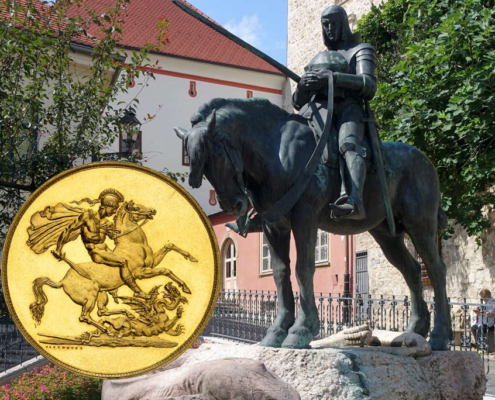
Salvator Medal in the weight of 12 ducats,
n. d.(around 1840).
NGC PF 61 CAMEO.
Proof.
Estimate: 15.000 Euro

1334City of Regensburg.
5 ducats, n. d. (1708–1710),
with the title of Joseph I. NGC MS 64.
Extremely rare. According to mint records,
only 7 copies struck.
A magnificent piece.
Estimate: 25.000 Euro

1602German New Guinea.
10 New Guinea Marks, 1895 A.
NGC MS 65.
A magnificent piece.
Estimate: 50.000 Euro

2757Saxony.
John Frederick the Magnanimous and
Maurice, 1541–1547.
Trinity Medal, 1544.
A masterpiece of German medal art. Magnificent,
excellent craftsmanship.
Estimate: 75.000 Euro

Archive: People and Markets

Die Study of the Yehud Coinage

The Israel Numismatic Society published a book on provincial silver coinage of Judah in the late Persian, Macedonian, and early Hellenistic periods. Haim Gitler, Catharine Lorber and Jean-Philippe Fontanille presented their die study recently in Jerusalem.

50 Years of Alpha Bank Numismatic Collection: “The Other Side of the Coin”

50 years ago the Alpha Bank Numismatic Collection was created. Now, an anniversary exhibition in Athens presents 150 coins from the collection illustrating “The Other Side of the Coin”: coins as means of communication and objects of art.

Royal Dutch Mint and Osborne Coinage Join the Heimerle + Meule Group

It was only recently that we posted about the acquisition of Reischauer by the Heimerle + Meule Group – but the next big announcement follows right away: the company acquired all shares in the Royal United Mint, who is the parent company of well-known businesses like the Royal Dutch Mint and Osborne Coinage.

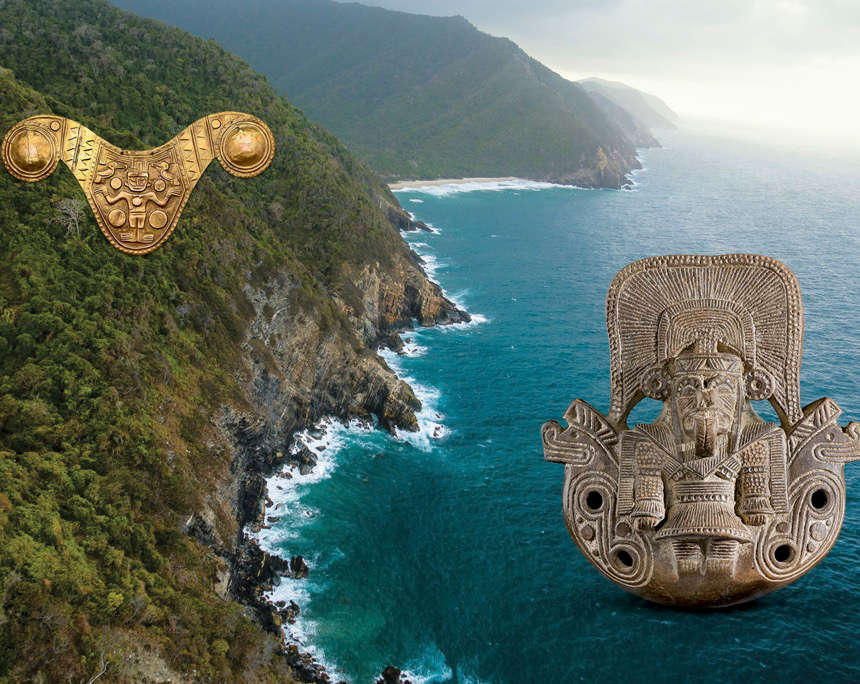
Brustplatte mit mythischem Wesen. Goldlegierung. Kolumbien, Sierra Nevada de Santa Marta (Nahuange-Tradition). The Museum of Fine Arts, Houston, Schenkung von Alfred C. Glassell, Jr. Okarina in Form eines sitzenden Anführers mit herausgestreckter Zunge. Keramik. Kolumbien, Sierra Nevada de Santa Marta (Tairona-Tradition). Los Angeles County Museum of Art, The Muñoz Kramer Collection, Schenkung von Camilla Chandler Frost und Stephen und Claudia Muñoz-Kramer. Landschaftsbild: © Museum Associates/LACMA.

More than Gold – Splendour and Thought in Indigenous Colombia

A new exhibition at Zurich Museum Rietberg is dedicated to the diversity of artistic production in pre-Hispanic Colombia. On display are spectacular gold objects.

Archive: Coins, Medals and more
The Bending Willow Tree

On 29 January 2025, Künker is going to auction off a unique willow tree coin. The reverse of the 10-ducat piece depicts a willow tree in a storm. But what is the message that William V, the Landgrave of Hesse-Kassel on whose behalf the coin was created, wanted to convey with this issue?
At the end of third century AD, Carausius and Allectus successively ruled Britain, and parts of the Continental coast, as rebel emperors for a period of ten years. A new book, published by Spink Books, aims to tell the incredible story of these two rebel emperors. Learn more about them and their rich coinage in this article.

Rebel Emperors of Britannia: Carausius and Allectus

At the end of the third century AD, Carausius and Allectus successively ruled Britain, and parts of the Continental coast, as rebel emperors for a period of ten years. A new book, published by Spink Books, aims to tell the incredible story of these two rebel emperors. Learn more about them and their rich coinage in this article.
Search Search