154Prussia. Frederick William IV, 1840–1861.
Gold medal in the weight of 50 ducats
commemorating the publication of the second volume
of Alexander von Humboldt’s *Kosmos*.
NGC MS 65 PL.
From the estate of Emperor William I.
Estimate: 40.000 Euro

166Prussia. Frederick William IV, 1840–1861.
Gold medal in the weight of 50 ducats commemorating
the unveiling of the equestrian statue of
Frederick the Great on Unter den Linden in Berlin in 1851.
NGC MS 63 PL.
From the estate of Emperor William I.
Estimate: 25.000 Euro

191Prussia. William I, 1861–1888.
General’s Medal in the weight of 120 ducats, 1871,
commemorating the victory over France.
A magnificent specimen.
From the estate of Emperor William I.
Estimate: 75.000 Euro

297Russia. Nicholas I, 1825–1855. Family ruble.
1 1/2 rubles (10 zlotys), 1835, St. Petersburg.
NGC MS 64 (Top Pop).
Only 36 examples struck.
A cabinet piece from polished dies.
From the estate of King Frederick William IV.
Estimate: 250.000 Euro

1098Holland. Province.
5 ducats, 1681.
Struck with the dies of a guilder.
NGC PF 64 Cameo.
Proof.
Estimate: 40.000 Euro

1192HRE. Ferdinand II, 1592–1618–1637.
5 ducats, 1634, Vienna.
Extremely rare.
Extremely fine-uncirculated.
Estimate: 10.000 Euro

1266HRE. Vienna.
Salvator Medal in the weight of 12 ducats,
n. d.(around 1840).
NGC PF 61 CAMEO.
Proof.
Estimate: 15.000 Euro

1334City of Regensburg.
5 ducats, n. d. (1708–1710),
with the title of Joseph I. NGC MS 64.
Extremely rare. According to mint records,
only 7 copies struck.
A magnificent piece.
Estimate: 25.000 Euro

1602German New Guinea.
10 New Guinea Marks, 1895 A.
NGC MS 65.
A magnificent piece.
Estimate: 50.000 Euro

2757Saxony.
John Frederick the Magnanimous and
Maurice, 1541–1547.
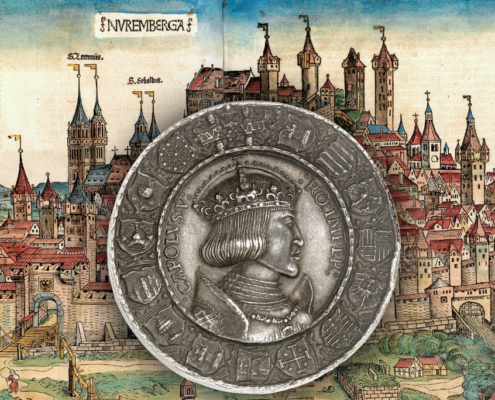
Trinity Medal, 1544.
A masterpiece of German medal art. Magnificent,
excellent craftsmanship.
Estimate: 75.000 Euro

Archive: People and Markets
A New Member to Join the SINCONA Team: Michael Otto

The SINCONA team is excited to welcome a new member. As of 1 January 2025, Michael Otto is working at the SINCONA Group’s headquarters in Zurich. He is looking forward to taking over the position as Head of Numismatics.

Successful December 2023 HKINF

The organizers of the 11th Hong Kong International Numismatic Fair (HKINF) are grateful for the positive feedback they received for the event. The date of the next HKINF has now been announced. Tables are still available.

Ollie Croker, Project Curator Recovery Programme, and Sara Aly. Art Market Expert Recovery Programme. Photo: British Museum.

Further Recoveries of British Museum Objects

The British Museum has announced the return of a further 268 missing objects, taking the total number of recovered items to 626. The museum also confirmed that it is currently working on new leads for around 100 additional objects.

After being kept untouched for 100 years, the Bruun collection with an insurance value of over 70 million USD will be auctioned at Stack’s Bowers.

After 100 Years: The Bruun Collection Comes Under the Hammer

The Bruun Collection has been held by Denmark’s National Museum in Copenhagen for 100 years. Now Stack’s Bowers Galleries has been commissioned with the sale of the collection, which Stacks refers to as “the most valuable collection of World Coins to ever come to market”.

Archive: Coins, Medals and more

Naval battle near Elseneur. Painting by Peter van de Velde. Coin: Netherlands / Holland and West Frisia. Pattern for the 1670 scheepjesschelling. Very rare. Very fine. Estimate: 200 euros. From Künker 414 (27/28 September), No. 4447.

Bloody Flag and Scheepjesschelling

On 27 and 28 September 2024, Künker will auction off part 2 of the Beuth Collection with Dutch coins in collaboration with Laurens Schulman. This important collection includes numerous rarities. But it also contains affordable coins with two-digit estimates that are just as fascinating as their unique and extremely rare counterparts, as we will prove in this article.
Karl Ludwig von Bruck, the mastermind behind the Vienna Coinage Treaty. We chose not to depict Emperor Franz Josef I at this point, who is shown on the coins, but the liberal politician Karl Ludwig von Bruck. Born into the family of a bookbinder in Elberfeld (now Wuppertal, Germany), he worked his way up from a merchant’s position to become Austria’s finance minister. He could almost be described as a beacon of hope for Austrian economic policy. It was tragic – and not just for him personally – that Franz Josef “ungraciously” dismissed him in April 1860 on false suspicions. The then 61-year-old took his own life. This deprived Austria of an imaginative politician who might have prevented its economic marginalization by Prussia.

A War Fought with Unusual Weapons: How Prussia Used Finance and Politics to Force the Habsburg Hereditary Lands Out of the German Confederation

On 26 March 2024, the Künker auction house will offer the Tursky Collection with coins of Emperor Franz Joseph I. We use specimens from this collection to tell the story of how Prussia used its economic sway to become the sole hegemonic power in Germany.
Search Search