154Prussia. Frederick William IV, 1840–1861.
Gold medal in the weight of 50 ducats
commemorating the publication of the second volume
of Alexander von Humboldt’s *Kosmos*.
NGC MS 65 PL.
From the estate of Emperor William I.
Estimate: 40.000 Euro

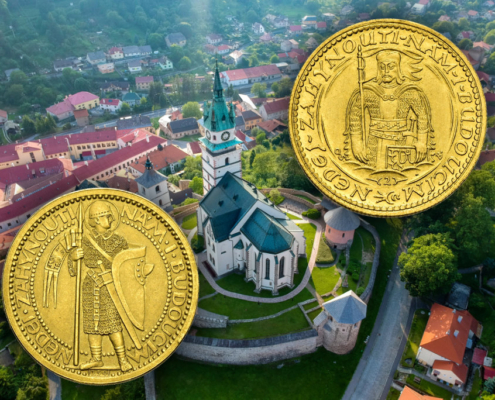
166Prussia. Frederick William IV, 1840–1861.
Gold medal in the weight of 50 ducats commemorating
the unveiling of the equestrian statue of
Frederick the Great on Unter den Linden in Berlin in 1851.
NGC MS 63 PL.
From the estate of Emperor William I.
Estimate: 25.000 Euro

191Prussia. William I, 1861–1888.
General’s Medal in the weight of 120 ducats, 1871,
commemorating the victory over France.
A magnificent specimen.
From the estate of Emperor William I.
Estimate: 75.000 Euro

297Russia. Nicholas I, 1825–1855. Family ruble.
1 1/2 rubles (10 zlotys), 1835, St. Petersburg.
NGC MS 64 (Top Pop).
Only 36 examples struck.
A cabinet piece from polished dies.
From the estate of King Frederick William IV.
Estimate: 250.000 Euro

1098Holland. Province.
5 ducats, 1681.
Struck with the dies of a guilder.
NGC PF 64 Cameo.
Proof.
Estimate: 40.000 Euro

1192HRE. Ferdinand II, 1592–1618–1637.
5 ducats, 1634, Vienna.
Extremely rare.
Extremely fine-uncirculated.
Estimate: 10.000 Euro

1266HRE. Vienna.
Salvator Medal in the weight of 12 ducats,
n. d.(around 1840).
NGC PF 61 CAMEO.
Proof.
Estimate: 15.000 Euro

1334City of Regensburg.
5 ducats, n. d. (1708–1710),
with the title of Joseph I. NGC MS 64.
Extremely rare. According to mint records,
only 7 copies struck.
A magnificent piece.
Estimate: 25.000 Euro

1602German New Guinea.
10 New Guinea Marks, 1895 A.
NGC MS 65.
A magnificent piece.
Estimate: 50.000 Euro

2757Saxony.
John Frederick the Magnanimous and
Maurice, 1541–1547.
Trinity Medal, 1544.
A masterpiece of German medal art. Magnificent,
excellent craftsmanship.
Estimate: 75.000 Euro

Archive: People and Markets
Red Alert at the British Museum

Thousands of objects have disappeared from the British Museum – allegedly stolen by a senior curator. The matter was uncovered by an antiquities dealer, whose warnings fell on deaf ears. The museum’s director has stepped down, and this seems to be merely the tip of the iceberg.

The Winners of the COTY Award 2024

At the World’s Fair of Money, the winners of the prestigious Coin of the Year (COTY) Awards were honored. Find out here which coins won the category awards and which country took home the award for Coin of the Year.

A ‘reverse proof’ commemorative issue – this is the coin all 2-euro collectors wanted to have, but even those who paid for it could not get their hands on the coin. Photo: Monnaie de Paris

Monnaie de Paris Faces Criticism from Enthusiastic Collectors

As athletes around the world prepare to deliver top performances at the Olympic Games, the Monnaie de Paris – France’s prestigious mint – has disqualified itself in the eyes of many collectors for unsporting behaviour. What happened?

A reconstruction of what the gold necklace probably looked like. Illustration made by archaeologist Thea Eli Gil Bell. © Theo Eli Gil Bell, The Museum of Archaeology, University of Stavanger.

Baldrs Horse: Detectorist Makes “Find of the Century” in Norway

On the Norwegian island of Rennesøy, a metal detectorist recently made an extraordinary gold find that was buried long before the Viking Age. The nine coin-like gold pendants engraved with rare horse symbols discovered along with ten gold beads and three gold rings are the first find of this kind in Norway since the 19th century.

Archive: Coins, Medals and more

Napoleon III, painting by Alexandre Cabanel, around 1865. It was the favourite portrait of Empress Eugénie because it was the most accurate depiction of him.

French History in Coins – Part 3: A New Napoleon

Under Emperor Napoleon III, France experienced an economic upswing. The Paris cityscape was completely revamped, just as coin designs. The gold rush in the US thrust Europe’s silver money into a crisis. The answer came from France.
The courtyard of the Alcazár of Seville was immortalised on a 2024 2-euro coin from Spain. Photo: Real Casa de la Moneda (coin), javarman3 / Getty Images Pro via Canva Pro

The Secret of the Success of State Quarters, UNESCO Coins and Federal State Series

25 years ago, the United States of America started a new chapter in numismatic history. Their State Quarters became the model for many other successful coin programs – including Spain’s UNESCO World Heritage Site series.
Search Search