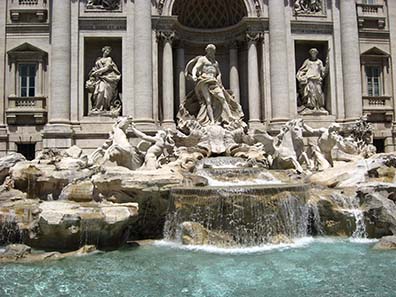
Coins in the fountain well: Trevi Fountain in Rome
Do you know actually, who invented the fashion to throw a coin into the Trevi Fountain in Rome in order to return to the Eternal City? If you do not, you will find the answer within this article…
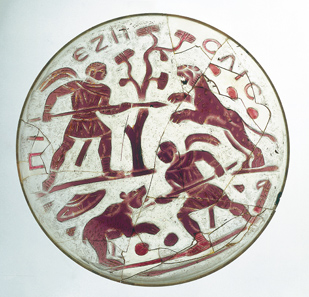
Why do so many Baroque coins and medals refer to hunting? This question comes to mind due to the Hirsch Nachf. sale 333 on September 21, 2017, in which the collection of a hunter (and collector) will be auctioned off. It contains a large variety of Baroque hunting scenes.
Henry VIII is renowned for his many wifes. Behind these marriages was his endeavour to unite love and a secure dynasty. On behalf of this goal he even broke with the Pope and the church.
By examining 12 coins we are going to stroll through Great Britain’s history – this is part 6.
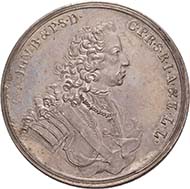
In 1701, the Treaty of Hamburg ended the dispute over Mecklenburg-Güstrow between Friedrich Wilhelm I and Adolf Friedrich II. And another dispute culminated in the medals minted to mark the treaty, namely the one between the mint-master and the warden of the Schwerin mint. We are telling you the story.
He was one of France’s most powerful kings, this Philip the Fair who humiliated the pope, crushed the Templars and humbled the Plantagenets. But 14 years after his death the house of the Capetians had ended. Now the question was: Who was to reign over mighty France?
Recte et constanter – uprightly and firmly, this is the motto under which empress Wilhelmine Amalia had taken up the reign. And uprightly and firmly did she act after her husband’s death as well. That is what is presented on an impressive medal offered at Künker.
It is rather unspectacular what can be seen on German 1, 2 and 5 Cent coins: a simple oak branch – boring, one might say. However, the oak symbol is very old and closely connected with Germany, its national identity and its democracy for nearly 300 years…
On May 31, 1740, Frederick II succeeded his father on the throne, soldier-king Frederick William I. To the 28 year-old, that came as some kind of liberation. Finally, he was able to carry out his ideas.
Frederick August I, August the Strong, as he loved to call himself, was highly gifted and ambitious. “Little” Saxony was not enough for him, he wanted to join the game of international politics. A splendid opportunity occurred in 1696 when the Polish King had died…
On February 4th, 2016, Künker will offer a French 5 franc gold pattern of year 10 for sale. The type can be traced back to the French Directory and it was only changed when Napoleon was certain of his power.
We are the bridge connecting the international numismatic world. Our readers include collectors, professional coin dealers and researchers, as well as all those involved in coin production. We are read in 170 countries! We provide you with information on everything you want to know about the subject of money – from antiquity to the present day. And much more...
Follow us
You need to load content from reCAPTCHA to submit the form. Please note that doing so will share data with third-party providers.
More InformationYou are currently viewing a placeholder content from Facebook. To access the actual content, click the button below. Please note that doing so will share data with third-party providers.
More InformationYou are currently viewing a placeholder content from Instagram. To access the actual content, click the button below. Please note that doing so will share data with third-party providers.
More InformationYou are currently viewing a placeholder content from X. To access the actual content, click the button below. Please note that doing so will share data with third-party providers.
More Information